Paving advice
When to redo your asphalt driveway
Seven signs ranked by urgency
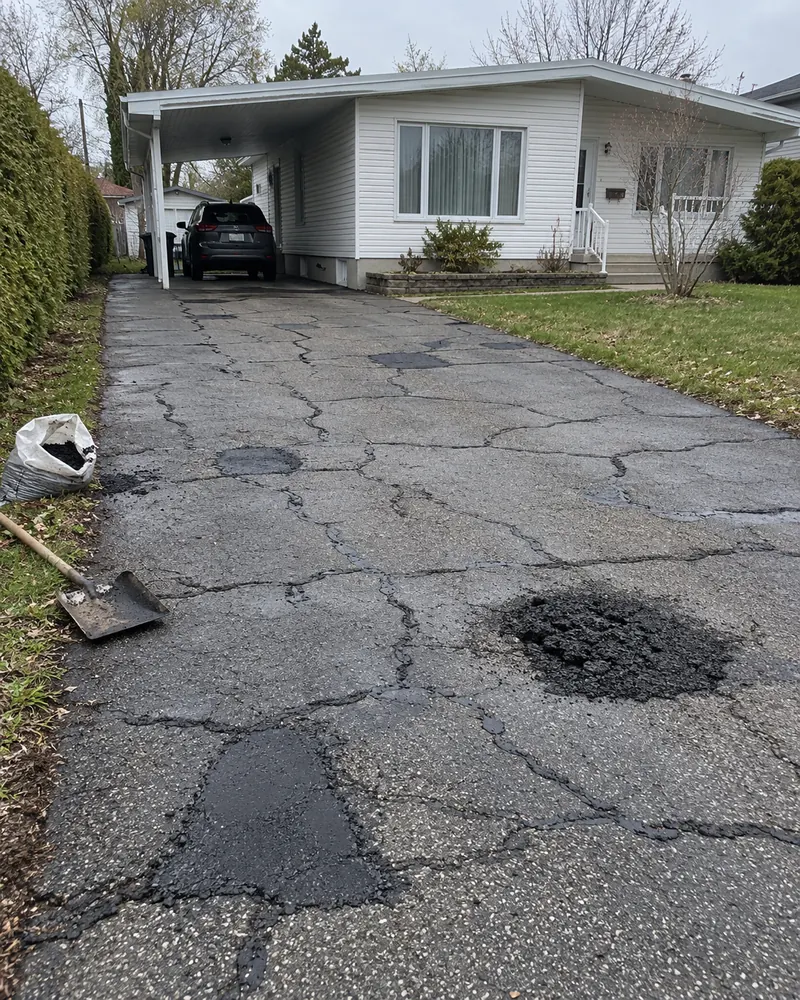
A driveway doesn’t need redoing because it is 20 years old, but because its base no longer carries the load. Seven signs tell you, and not all of them call for a rebuild: some are fixed for $150, others mean a driveway to rebuild.
- Free quoteWe come take a look, no obligation.
- Clear priceEvery step spelled out in the quote.
- Hot asphaltLaid with a paver, rolled.
- Quick callbackThe owner, not a salesperson.
On this page
The short answer
An asphalt driveway needs redoing when the damage comes from the base: alligator cracking over a large area, dips that hold water, bumps that come back every winter. A grey surface, isolated cracks or a pothole are fixed without a rebuild, by sealing, a repair or resurfacing. In 2026, a fully rebuilt driveway costs $6 to $10 per square foot.
The seven signs, most urgent first
| Sign | What it means | Urgency | The fix, 2026 price |
|---|---|---|---|
| 1. Water running toward the house or garage | Reversed slope | Before winter: the water freezes against the house foundation | Rebuild with new slopes, $6–10/ft² |
| 2. Alligator cracking over a large area | The base flexes under the wheels | This season | Rebuild |
| 3. A bump that comes back every winter | Water freezing in poorly drained soil | This season | Rebuild with drainage |
| 4. Pothole | Water and tires tore out the mix | Before winter: the plough blade enlarges it | Hot repair, quoted by area and depth |
| 5. Local dip that holds water | Stone settled in one spot | Before winter | Zone redone down to the stone |
| 6. Crumbling edge | No side support | Before snow gets pushed onto it | Edge rebuilt on stone |
| 7. Grey surface, fine or isolated cracks | Oxidized bitumen, sound structure | Not urgent | Cracks sealed for $250–400 below 200 linear feet, sealcoat or resurfacing |
The first three signs come from the base: no layer and no sealer fixes them. The next four can be repaired, as long as they aren’t left through several winters.
One of these signs at your place? A first read in 2 minutes, then a free visit
What happens when you wait
Asphalt damage doesn’t stay at the same stage. The usual progression, winter after winter:
- A fine shrinkage crack, harmless.
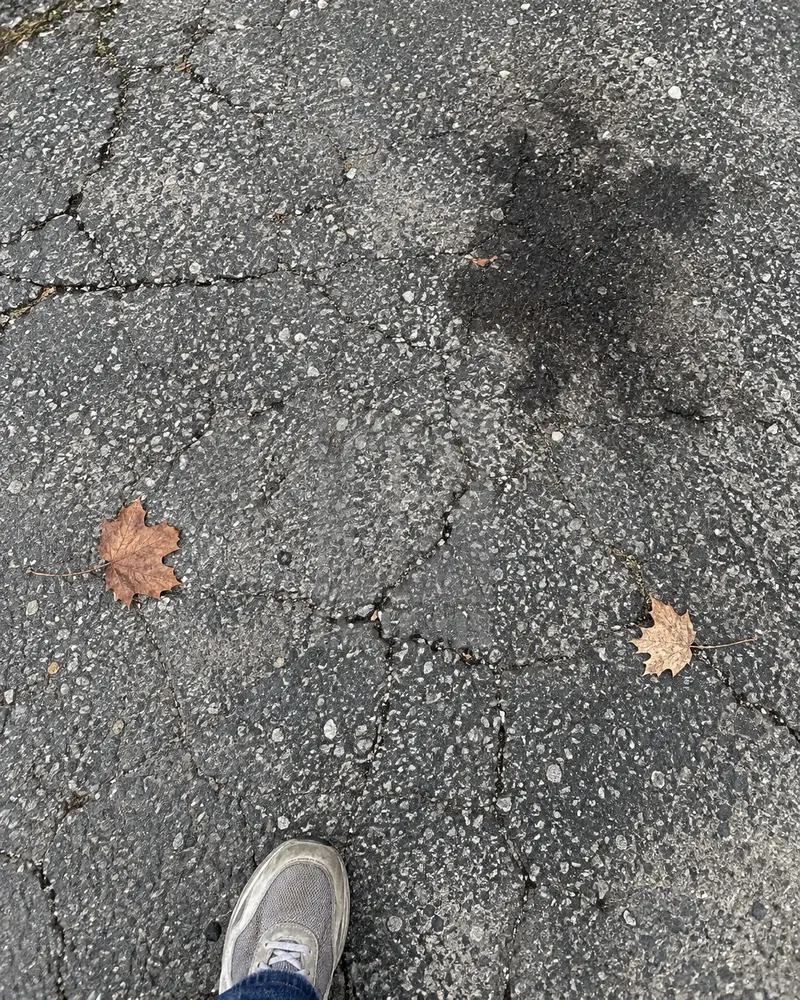
- The crack opens past 3 mm: water gets in, and the Montréal area has 67 to 85 freeze-thaw days a year.
- The edges break and the crack passes 20 mm; it can no longer be sealed, it has to be cut out.
- A pothole forms where the wheels run.
- The stone washes out under the hole; a dip forms around it.
- The zone breaks into a web of cracks: the base has failed there.
Closing the crack at stage 2 costs $250–400 below 200 linear feet. At stage 6, the whole zone has to be rebuilt, at $6–10/ft². Québec’s transport ministry gets 4 to 8 years of service from crack sealing on its regional roads: it is the step that pays back the most.
The driveway’s age: a clue, not a rule
| Age | What we often see | What we check |
|---|---|---|
| Under 5 years | Early cracks or dips | The base: a well-built driveway shouldn’t show any of this |
| 5 to 15 years | Isolated cracks, surface turning grey | Cracks to seal, sealcoat if the surface is losing aggregate |
| 15 to 25 years | Worn surface everywhere, more cracks | If the base holds: resurfacing; otherwise, a rebuild |
| Over 25 years | Web of cracks, dips | A rebuild is often the only lasting option |
The National Association of Home Builders study gives an asphalt driveway 15 to 20 years on average, and the CAA-Québec sheet more than 20 years when the base, thickness and drainage are done right. The figures by source are in our article on how long a driveway lasts.
The right time of year
- Repairing cracks and potholes: as soon as you see them, from mid-May to late fall, in dry weather. Before winter, it is the priority.
- Rebuilding or resurfacing: as long as the asphalt plants are producing and the surface is dry and not frozen. A layer of 50 mm or more can still go down on a cool November day, under the transport ministry’s minimum temperatures.
- Sealcoating the surface: on a day of at least 10 °C, never before 6 months on new asphalt.
Before you sign, our article resurfacing or rebuilding gives the test that decides between the two options, and the guide on how to choose a paving contractor the questions to ask.
We come by for free and tell you what is urgent and what can wait
Frequently asked questions
At what age should an asphalt driveway be redone?
There is no set age: a driveway is redone when its base no longer carries the load. On average, an asphalt driveway lasts 15 to 20 years, and more than 20 when it was built to the rules.
Does a cracked driveway need to be redone?
Not always. Isolated 3–20 mm cracks are hot-sealed for $250–400 below 200 linear feet. Alligator cracking over a large area, on the other hand, means a base to redo.
How much does it cost to redo an asphalt driveway in 2026?
$6 to $10 per square foot before tax, or $2,400 to $4,000 for a 400 ft² double driveway. Resurfacing, when the base holds, costs $3 to $5.50/ft².
Can repairs wait until spring?
A grey surface can wait. An open crack, a pothole or a crumbling edge gets worse over the winter: water freezes in it dozens of times and the plough blade breaks its edges.
How do I know it’s the base?
Three signs give it away: a dip that holds water after rain, alligator cracking where the wheels run, and a bump that comes back every winter. We confirm it during the visit by probing the edge of the driveway.
Sources
- Québec transport ministry, crack-sealing practice (3–20 mm, 4 to 8 years of service) and Cahier des charges et devis généraux, art. 13.3.4 (minimum paving temperatures).
- Federal Highway Administration, Distress Identification Manual (alligator cracking, edges, potholes).
- Environment and Climate Change Canada, 1991–2020 climate normals (freeze-thaw days).
- National Association of Home Builders and Bank of America, Study of Life Expectancy of Home Components (2007); CAA-Québec and Bitume Québec, technical sheet on the asphalt driveway (2011).
- Prices: Casabella Pavage, Les Pavages Guilmain and scellementasphalte.ca, compiled on our price page.
2026 prices in detail: sources and calculator.
Go further.
How many years does an asphalt driveway last in Quebec?
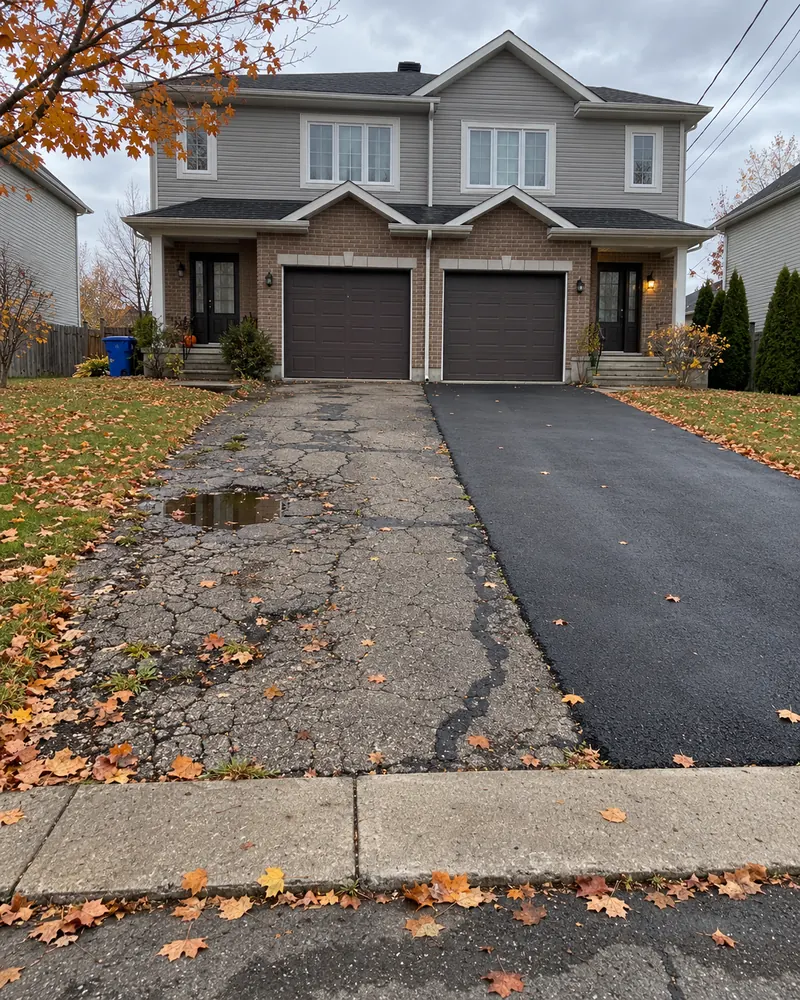
Built right, an asphalt driveway lasts 15 to 20 years or more in Quebec. The 6 benchmarks to demand, how to read the damage, and the cost per year of each fix.
Read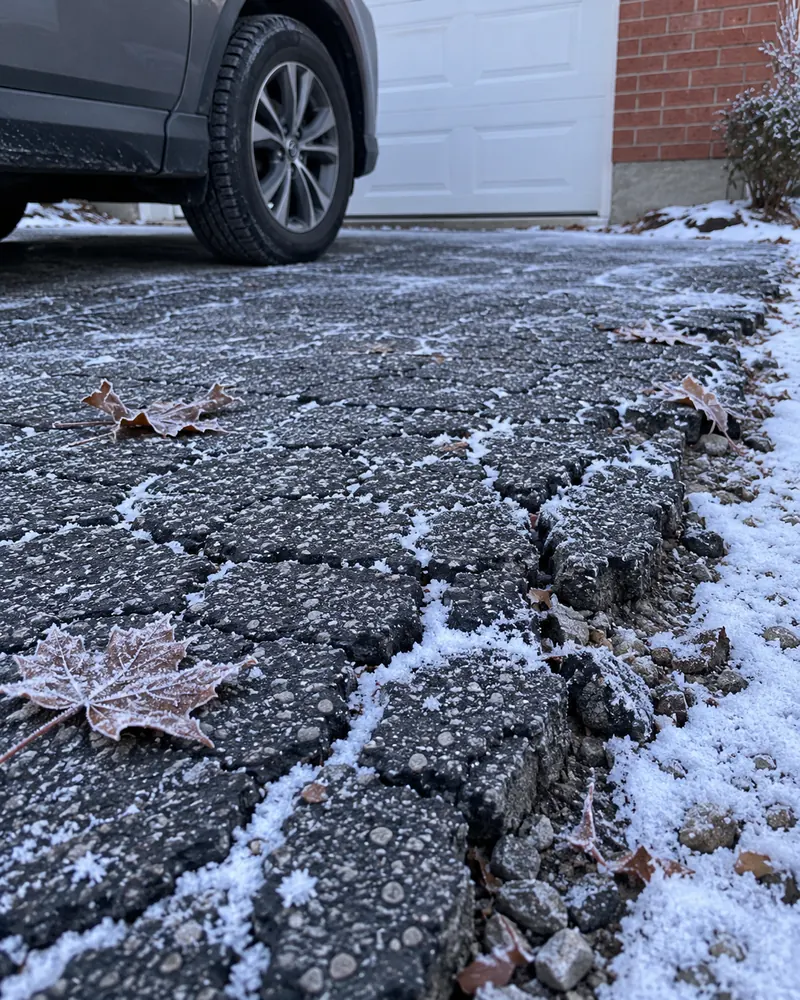
Your asphalt driveway and winter: what to do in October, in January and at the thaw
What to do for your asphalt driveway before the snow, during winter and at the thaw: cracks to close before the freeze, markers, de-icers, the plough blade, Tempo shelters and heavy trucks in spring.
Read
Resurfacing or rebuilding: the five-step test to find out what your driveway needs
Overlay or redo your driveway? The 3 m straightedge test, reading the cracks, probing the edge, the cost per year of each option and the combined fix that often costs least.
ReadBefore the freeze, not next spring.
Describe your project in two minutes. We call you back quickly, come take a look and you get your price, free.