Frequently asked questions · Asphalt and Tempo shelters
Asphalt paving in Quebec: answers with numbers
2026 prices, thickness, paving temperatures, when to park, frost, sealer, permits and Tempo shelters: every answer gives the number and where it comes from.
- Free quoteWe come take a look, no obligation.
- Clear priceEvery step spelled out in the quote.
- Hot asphaltLaid with a paver, rolled.
- Quick callbackThe owner, not a salesperson.
On this page
What homeowners and property managers ask us before, during and after asphalt work, with the numbers that settle it: prices published in 2026, standards from Quebec’s Ministry of Transport, Environment Canada data and municipal bylaws. Sources are at the bottom of the page; for your own driveway’s price, the quote questionnaire takes two minutes.
The key numbers
| Topic | The number | Source |
|---|---|---|
| Rebuilt driveway, excavation included | $6–10/ft² (400 ft²: $2,400 to $4,000 before tax) | Prices published in Greater Montréal, 2025–2026 |
| Resurfacing, sound base | $3–5.50/ft² | Published prices, 2025–2026 |
| Sealcoating by a contractor | $265–300 up to 600 ft² | Published prices, 2025–2026 |
| Hot-sealed crack | $250–400 below 200 linear feet | Published prices, 2025–2026 |
| Stone under a private driveway rebuilt by the city | 300 mm of MG-20 compacted to 95% | City of Laval |
| ESG-10 surface mix | 40 to 70 mm per layer | Ministry of Transport |
| Air temperature to pave | above 10 °C under 50 mm compacted, above 2 °C for thicker layers | Ministry of Transport |
| Ground frost depth | 1.2 m to over 3 m depending on the region | Ministry of Transport |
| Freeze-thaw days in our cities | 67 to 85 a year | Environment Canada |
| Before parking on new asphalt | 3 days, 5 in very hot weather | Our job-site rule |
| First sealcoat | not before 6 months | Manufacturer Henry |
| Utility locate | free, at least 3 business days | Info-Excavation |
| Tempo shelter installed | Quote required | For your project |
Where does your driveway land in these ranges? We’ll come look at it for free
Frequently asked questions
What does a rebuilt asphalt driveway cost in 2026?
Fully rebuilt in Greater Montréal, with excavation, a stone base and 2.5 in of asphalt, a driveway costs $6–10/ft². For 400 ft², the size of a double driveway, expect $2,400 to $4,000 before tax, or about $2,760 to $4,600 with GST and QST. Over a sound base, resurfacing runs $3–5.50/ft² instead. The excavation depth explains most of the gap: the full 2026 price breakdown, calculator included.
What lifespan can you expect from an asphalt driveway in Quebec?
Up to 20 years when it is well designed, well built and maintained, according to the asphalt pavement associations of Wisconsin and Colorado, two cold-winter regions. Here, the enemy is water: our cities see 67 to 85 freeze-thaw days a year, and each one widens the cracks water has found. On a thick, compacted, well-drained stone base, a driveway ages slowly; on a thin base, it starts cracking in a web after a few winters. Sealing cracks every fall is the most cost-effective upkeep there is.
When can you pave a driveway in Quebec?
From the spring thaw until the asphalt plants close in late fall, on ground that isn’t frozen. The ministry’s specifications set the thresholds: above 10 °C and rising for a layer under 50 mm once compacted, above 2 °C and rising for a thicker layer, on a surface free of water and ice. At 2.5 in (about 63 mm) compacted, a driveway falls in the second category, which keeps the mild days of October and November open. The ministry itself leaves November out of the time it allows for its own paving contracts: the window closes fast.
How many days should you wait before parking on new asphalt?
Three days before you park a car on it, five in very hot weather: until the asphalt has cooled all the way through, the mix stays soft. For the first few weeks, don’t turn the steering wheel while stopped, keep moving trucks, dumpsters and trailers off the driveway, and slip a piece of plywood under a trailer jack or jack stand, as the Wisconsin Asphalt Pavement Association advises. Light tire marks fade on their own.
How long should you wait before sealing a new driveway?
At least 6 months, according to the manufacturer Henry; the Asphalt Institute says a well-built driveway shouldn’t need it for about 2 to 5 years. After that, manufacturers recommend a thin coat every 2 to 4 years, above 10 °C, once the surface turns grey and starts losing aggregate. Sealer protects the surface without adding any strength, and coal-tar products have been banned from sale in Canada since the end of 2025. The details: when sealer helps and when it’s money wasted.
Do you need a permit to redo a driveway at the same size?
In most of the suburbs we serve, no: Laval (3 dwellings or fewer), Brossard and Mirabel require nothing for a house driveway kept to the same dimensions. Widening the driveway, moving the curb cut or touching the curb needs approval almost everywhere, and the curb cut is done by the city or a contractor it hires, then billed to the owner: $226 up to 4 m in Longueuil. In Lorraine, even replacing the paving is on the list of regulated work, and in Montréal each borough sets its own rules; Saint-Laurent requires a certificate even to resurface. The rules in all 16 cities.
Which cities do you work in?
Sixteen: Montréal and Laval; on the North Shore, Blainville, Bois-des-Filion, Boisbriand, L’Assomption, Lorraine, Mascouche, Mirabel, Repentigny, Rosemère, Saint-Eustache, Sainte-Thérèse and Terrebonne; on the South Shore, Brossard and Longueuil. Each city has its own page with its permit rules: see our service areas. Elsewhere in Quebec, describe your project and we’ll quickly tell you whether we can take it on.
Repair, resurface or rebuild
The right job depends on what’s happening under the asphalt, not on the driveway’s age. Here’s how we read a driveway on a visit.
| What you see | What it means | The right job | 2026 published prices |
|---|---|---|---|
| Grey surface, loose aggregate | The binder has oxidized; the structure holds | Crack filling, then sealcoat | $265–300 up to 600 ft² |
| Long, isolated cracks | Thermal shrinkage or age | Hot-poured crack sealing | $250–400 below 200 linear feet |
| One or a few potholes | A crack let water in | Cut out, recompact the base, fill with hot mix | quoted by area and depth |
| Worn surface everywhere, still flat | Sound base | Resurfacing | $3–5.50/ft² |
| Alligator cracking, puddles, dips | The base has failed | Excavation and a new base | $6–10/ft² |
Not sure which row describes your driveway? Text a photo or ask for the free visit
Can you put a new layer over old asphalt?
Yes, if the base underneath is sound. We first repair the holes and large cracks, spray a tack coat, then lay 1.5 to 2 in of hot mix, the usual overlay thickness according to the Colorado Asphalt Pavement Association. The surface rises by the same amount, so we mill the old asphalt at the garage threshold, the sidewalk and the street to avoid a step. On a driveway that’s wavy or cracked in a web, the new layer copies the defects: resurfacing or rebuilding, how to decide.
Does resurfacing fix a sunken area?
No: a dip means the base has settled or washed out, and a new layer simply follows its shape. A single sunken spot gets fixed before resurfacing by cutting out the area, rebuilding the stone and compacting it. Several dips, puddles after every rain or heaving every winter mean the whole base has to be redone.
Can you pave straight over a gravel driveway?
Rarely without work: the gravel in a temporary driveway almost never has the thickness and compaction to carry asphalt. As a benchmark, the City of Laval requires 300 mm of MG-20 compacted to 95% when it rebuilds a private driveway; we top up or replace the stone, compact it in layers, then pave. Changing the surface type sometimes counts as a modification (Laval’s drainage bylaw makes it subject to a permit), so we check with the city before starting.
Should you choose asphalt or paving stones?
Asphalt, if budget and easy repairs matter most: $6–10/ft² for a fully rebuilt driveway versus $22–35/ft² for driveway-grade paving stones according to Soumission Rénovation (May 2026), so at most half the price. It is laid in a single day and patched section by section. Paving stones give more choice of shapes and colours, and sometimes they’re the only option: the Côte-des-Neiges–Notre-Dame-de-Grâce borough now allows only pavers or concrete reaching a solar reflectance index of 29 for a new or replacement parking area, and asphalt falls short of that threshold.
Why did asphalt prices go up in 2026?
Because bitumen, the binder in asphalt mix, rose 41% between January and September 2026: the ministry’s reference price for PG 58S-28 bitumen jumped from $945 to $1,335 a tonne. On a 2.5 in compacted layer, that’s about $0.27 to $0.29 more per square foot, or $160 to $175 for 600 ft². A 2026 price above a rate you read on a site that hasn’t touched its numbers in years usually reflects the real market.
Base, asphalt mix and thickness
What you can’t see once the driveway is finished decides how long it lasts: the stone thickness, its compaction, the mix and the slope.
How much stone goes under a driveway?
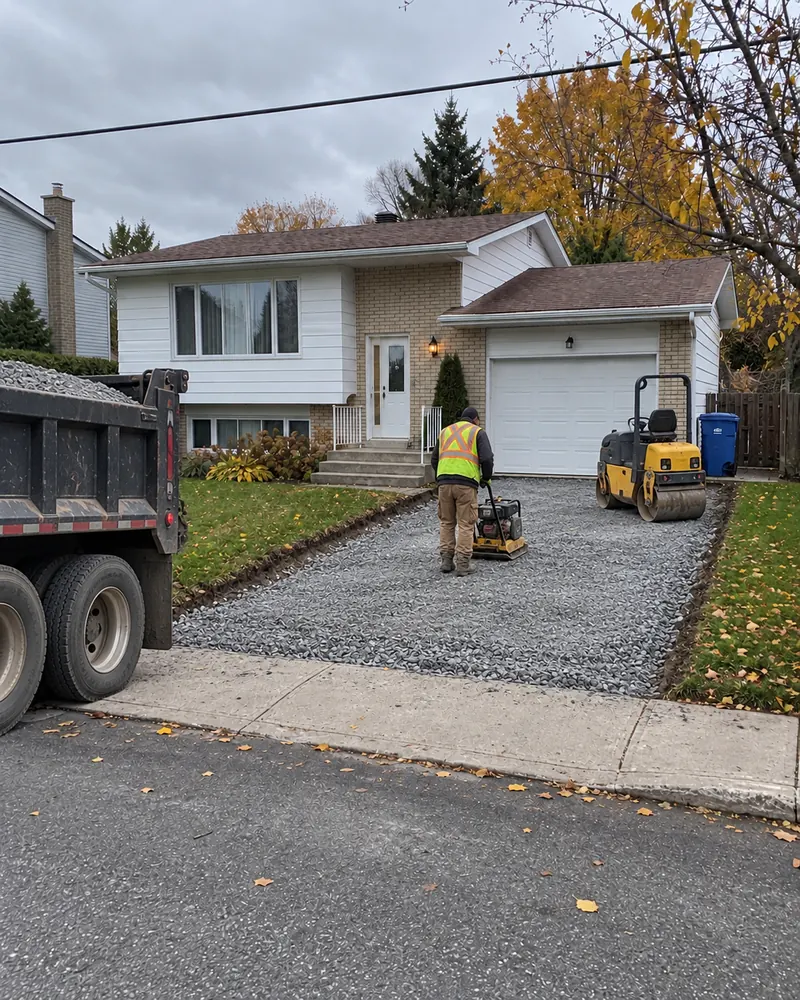
150 to 300 mm, depending on the soil. On good soil, the Colorado Asphalt Pavement Association considers 6 to 8 in (150 to 200 mm) of crushed stone usually adequate; when the City of Laval rebuilds a private driveway following municipal work, it requires 300 mm of MG-20 compacted to at least 95% of its maximum dry density. On clay soil, common in Laval, we aim for that municipal benchmark. Stone is compacted layer by layer: dumped all at once and compacted once, it keeps voids deep down that later settle under the wheels.
How thick should the asphalt be on a house driveway?
About 2.5 in, or 63 mm once compacted: that’s the thickness to specify in your quote. It sits within the range the ministry sets for ESG-10, its benchmark surface mix: 40 to 70 mm per layer, with 60 mm as the optimum. The City of Laval, for its part, calls for 50 mm on the private driveways it rebuilds. Always compare thickness after rolling: asphalt gets thinner under compaction, and 2 in spread out doesn’t make 2 in compacted.
EB-10S, EB-10C, ESG-10, EC-10: what’s the difference?
EB-10S and EB-10C are old names for Marshall-method mixes (standard 4201), dropped from the ministry’s tables in 2012, even though many pavers still use them. Current mixes fall under standard 4202: ESG-10, dense with a closed surface, is laid 40 to 70 mm thick; MUN-10, recommended as a surface course on streets with fewer than 2,000 vehicles a day, 40 to 60 mm; EC-10, very workable, is mainly a levelling (correction) mix, 20 to 40 mm. Ask for the mix name and its compacted thickness: two quotes that don’t name the same mix don’t describe the same driveway.
Why does compaction matter so much?
Because poorly compacted asphalt stays porous: water gets in, freezes and breaks it apart from the inside. The Asphalt Institute targets 3 to 7% air voids after compaction; at 8% and above, the voids connect and let air and moisture through. On its projects, the ministry accepts a day’s paving when average compaction falls between 93 and 98%, and rolling must be finished before the mix cools to 60 °C. A thin layer spread on cool ground can leave less than 10 to 20 minutes of useful rolling time, so the roller follows the paver without waiting.
What slope does a driveway need to drain?
At least a quarter inch per foot, about 2%, according to the Colorado Asphalt Pavement Association, toward the street, a ditch or a catch basin, never toward the house. A 30 ft driveway draining lengthwise therefore drops at least 7.5 in. A puddle that lingers after rain signals a slope or base problem: standing water eventually seeps in, then freezes under the asphalt.
Do you need to dig below the frost line?
No, and no driveway does: according to the ministry, Quebec ground freezes for more than four months a year, to depths of 1.2 m to over 3 m depending on the region. A driveway handles frost by other means: crushed stone that drains instead of holding water, enough thickness and a slope that carries meltwater away. Heaving comes from water in the base and frost-susceptible soil below, not from the cold alone.
On paving day
How long does the work take?
A house driveway is usually paved in a single day on site. With excavation and a new base, preparation takes a first day and the asphalt goes down a few days later. Before digging, locating underground utilities takes at least three business days: that lead time, more than the equipment, often sets the start date.
Who requests the utility locate from Info-Excavation?
We do, before every excavation. The service is free, and Info-Excavation processes a request in at least three business days, not counting the day it’s received. Its members locate their telecom, electrical and gas lines (stakes, flags, paint or a plan), but not every municipality is a member and your private lines aren’t marked: show us the drain, irrigation or lighting wires that run under the driveway. In 2025, 31% of the incidents Info-Excavation recorded happened without a locate request.
What happens if it rains on the scheduled day?
We reschedule. The ministry’s specifications only allow paving with no rain, drizzle or snow, on a surface that is neither waterlogged nor frozen: water cools the mix before the roller can compact it. You’re told the day before, and we set the new date with you on the same call.
A door-to-door seller offers me “leftover asphalt”: is it a good deal?
No. The Colorado Asphalt Pavement Association puts it bluntly: “There is no such thing as leftover asphalt,” because hot mix has to be laid and compacted while it’s hot. The “special” price gets paid another way: a thin layer spread with no base and no slope, by a company you can’t find come spring. Before signing with anyone, ask for a business address, the compacted thickness, the stone type and an invoice.
Winter, frost and maintenance
In our cities, the air swings across the freezing point 67 to 85 days a year, mostly in November and March. Each crossing works the water that has found its way into the asphalt.
Why does the driveway heave in winter and sink in spring?
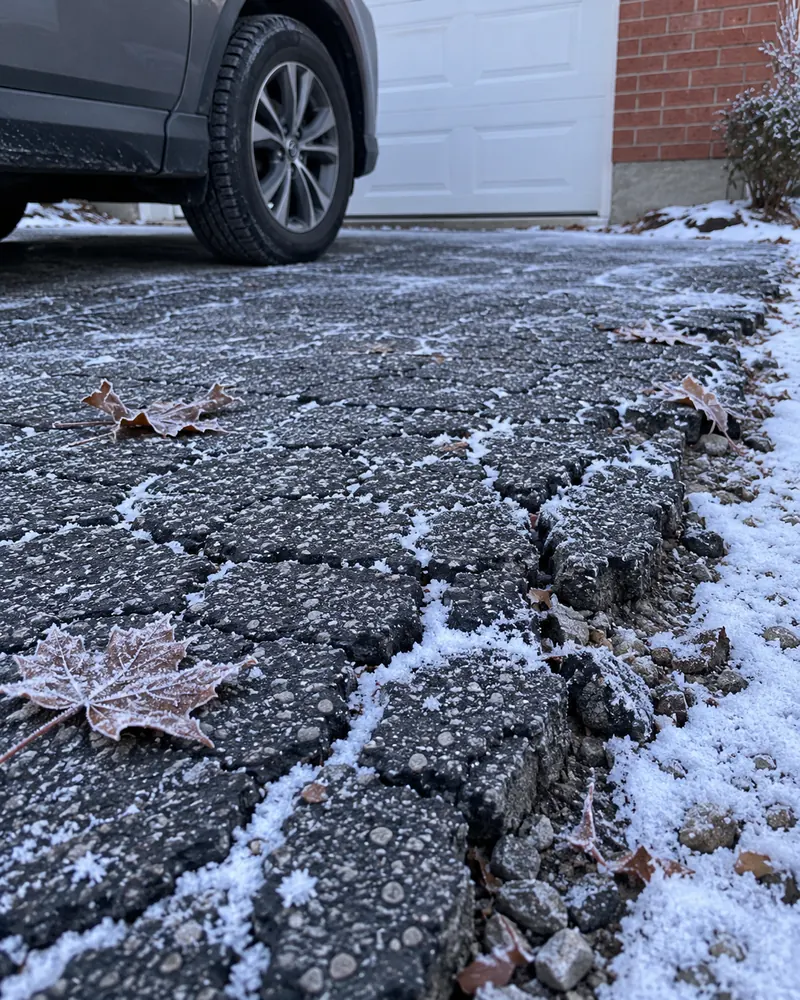
Because water under the asphalt freezes and expands, then thaws from the top down while the deeper, still-frozen soil keeps it from draining. Saturated, the pavement loses 30 to 70% of its strength according to the ministry, which cuts the loads allowed on trucks every spring; in 2026, those restrictions began on March 16 in the zone that covers Montréal. At home, keep trailers, dumpsters and heavy trucks off the driveway during the thaw.
Does de-icing salt damage asphalt?
Mostly through the water it puts to work: by lowering the freezing point, it multiplies freeze-thaw episodes in cracks and pores, and the effect adds up on a driveway that’s already cracked. Sand or fine gravel gives traction with no chemical effect: clear snow before ice forms and save de-icer for stubborn patches.
When should cracks be repaired?
Before the freeze, as long as the surface is dry and above about 5 °C. On its own roads, the ministry treats cracks 3 to 20 mm wide between mid-May and mid-October, at 5 to 30 °C, for 4 to 8 years of service on the regional network. According to the U.S. Federal Highway Administration, rubberized hot-pour sealant in a routed crack lasts 5 to 9 years, versus 2 to 4 years for a cold product. For a small job, L’Équipe Marcil publishes a $250–400 package below 200 linear feet. Another provider’s per-foot rate cannot replace that visit charge.
Will a pothole filled with cold patch hold?
Only as a stopgap: bagged cold asphalt ($13.99 for 30 kg at Canac) fills the hole without bonding to the edges or fixing the stone underneath. A lasting repair saw-cuts the edges square, recompacts the base, fills with compacted hot mix and seals the joints; the area, depth and mobilization determine the price of that repair.
Does sealer make the driveway slippery?
It can reduce traction slightly, especially when applied thick: Henry warns that an overly thick coat dries poorly and turns slippery when wet, and advises against its product on steep driveways. On a slope or in front of the garage, choose a sealer with sand filler, which improves traction according to the Colorado Asphalt Pavement Association, and apply it thin.
Commercial and condo parking lots
A parking lot is planned around the people who use it: customers, tenants, deliveries and snow removal. Our commercial paving applies the same base rules at a larger scale.
Can you redo a parking lot without closing our entrances?
Yes: we split the lot into zones redone one after another, with an entrance and an exit always open. The zone order, days and hours are set with you at the planning stage, which gives you time to notify tenants and customers; depending on the site, part of the work can be done in the evening or on weekends.
What structure does a lot with truck traffic need?
Thicker at every layer: more compacted stone and often two asphalt layers, for example a GB-20 base course (80 to 120 mm according to the ministry) under an ESG-10 surface. ESG-14 can also serve as a single layer, 60 to 80 mm. We size it to the site’s actual traffic: cars, delivery trucks, dumpsters and snowplows.
How much does parking lot line striping cost?
About $13 per standard stall and $65 per accessible stall, according to 2026 rates published by Groupe Soli. Include it in the same request as the paving: stalls, arrows and reserved areas are painted on asphalt that has hardened enough, and the phase schedule accounts for it.
Tempo shelters
Tempo shelter installation: single $199, double $299 before taxes; $329 and $449 with spring removal. See our prices and prices published elsewhere.
Your Tempo shelter set up, anchored and placed at the right distance: your price in 2 minutes
How much does Tempo shelter installation cost?
Triple, extra-long, walkway or door shelters and new permanent anchors are priced on the phone: the full Tempo shelter installation service. Tempo shelter installation: single $199, double $299 before taxes; $329 and $449 with spring removal. See our prices and prices published elsewhere.
From what date can you put up your shelter?
It varies by city. Terrebonne opens the season on October 1; Laval and most Montréal boroughs follow on October 15, Longueuil on October 24, then Brossard and Rosemère on November 1. Lorraine bans temporary shelters year-round. Removal deadlines range from April 15 in several cities to May 1 in Rosemère and Mirabel: dates for all 16 cities and the boroughs.
Do shelter anchors damage asphalt?
Not if they’re placed in the right spot. For an asphalt driveway, the manufacturer Tempo calls for either U-shaped anchors or permanent anchors: 4 at minimum up to 12 ft long, 6 between 16 and 20 ft, 8 between 24 and 32 ft, and no concrete blocks. U-shaped anchor spikes make new holes every fall; a permanent anchor makes do with a single 7/8 in hole. As pavers, we drill well clear of cracks and crumbling edges, then plug the holes that are no longer in use.
Do you need approval to put up a temporary car shelter?
Rarely: in our cities, only two ask for paperwork. Repentigny requires a work declaration, to be redone only if the shelter or its location changes, and L’Assomption a certificate of authorization, at no charge. Everywhere, the distance from the sidewalk or curb matters: in Laval, a first offence costs $400.
Price, visit and warranty
How do I get a price?
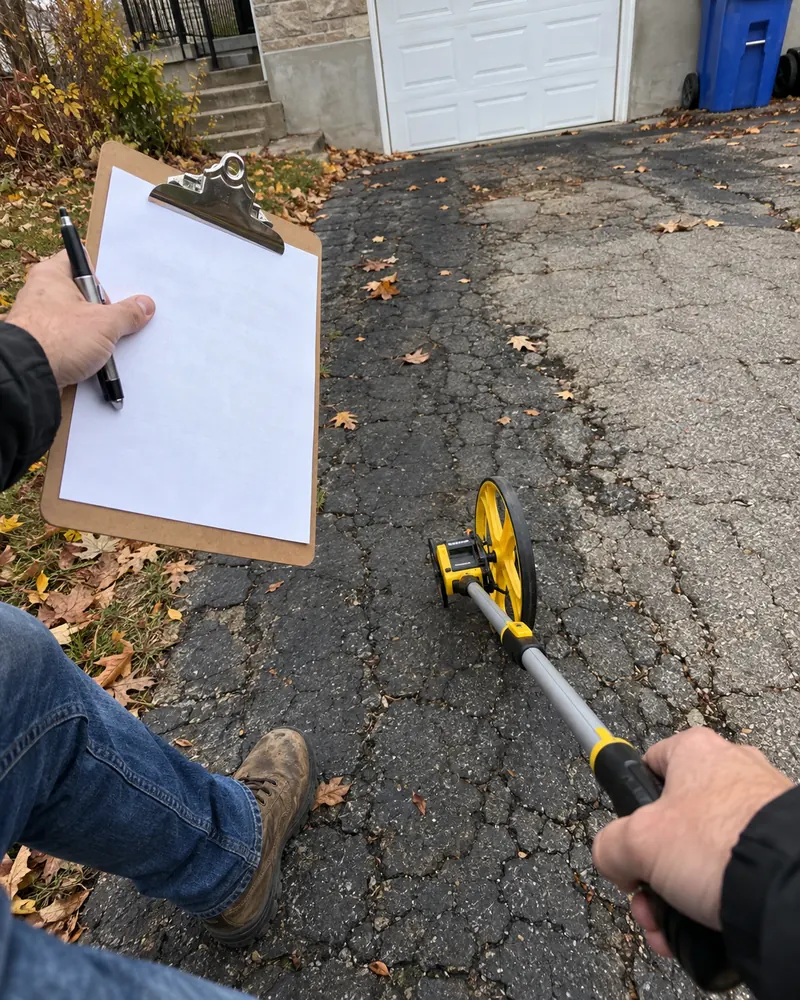
Fill out the two-minute quote questionnaire and describe your driveway. The owner calls you back quickly, on business days, then comes by to take the dimensions, probe the base at the edge of the driveway and check where the water goes. You then receive your price at no cost and with no commitment.
What should a paving quote spell out?
Six items, without which two prices can’t be compared: the area in square feet, the excavation depth, the stone type and its compacted thickness, the mix name and its compacted thickness, how slopes and transitions are handled, and the warranty period. A one-line quote leaves plenty of room for extras.
Is your work guaranteed?
Yes. Faulty workmanship or a defective material is covered for the period stated on your quote. The owner is on every job site: if there’s a problem, you know who to call, and we come back to fix it.
Your question isn’t here?
Ask us directly: fill out the two-minute questionnaire or use the request form. A photo sent by text is often enough to tell whether you need a repair, a resurfacing or a new driveway.
Describe your driveway: the owner calls you back with the right fix
Sources
Consulted October 24 to 26, 2026.
- Quebec Ministry of Transport and Sustainable Mobility (MTMD): Cahier des charges et devis généraux, Infrastructures routières, 2018 edition (sections 7.8, 13.3.2.2 and 13.3.4); Critères de sélection des enrobés (December 2024); Info-DLC, vol. 17, no. 3 (September 2012); En période de dégel, roulez léger (2026) and notice of March 12, 2026; bitumen reference prices, January to September 2026; crack-sealing bulletin (2003).
- City of Laval: special specifications for road infrastructure (section 7.7, reinstating private works); bylaw L-11870; “Abri d’hiver pour les véhicules” page.
- City of Montréal: Obtenir un permis pour aménager ou modifier un espace de stationnement (Côte-des-Neiges–Notre-Dame-de-Grâce, Saint-Laurent). Brossard, Mirabel, Longueuil, Lorraine, Repentigny and L’Assomption: official links in our permit and Tempo date guides.
- Info-Excavation (free service, processing time, 2025 statistic).
- Environment and Climate Change Canada: Canadian Climate Normals, 1981–2010 and 1991–2020.
- Asphalt Institute, technical FAQ; Colorado Asphalt Pavement Association, Asphalt Driveways (2020) and Best Practices for the Use of Asphalt Driveways (2005); Wisconsin Asphalt Pavement Association, driveway owner’s guide.
- U.S. Federal Highway Administration, FHWA-RD-99-147; U.S. Geological Survey, fact sheets 2011-3010 and 2016-3017; Henry HE130 data sheet; Canada Gazette, Part II, SOR/2025-36.
- Abris Tempo: anchor selection guide.
- Published prices: Casabella Pavage (December 2025), Les Pavages Guilmain (January 2026), scellementasphalte.ca, Scellant Rive-Nord, Groupe Soli (2026), Soumission Rénovation (May 2026), Canac (October 2026).
2026 prices in detail: sources and calculator.
Before the freeze, not next spring.
Describe your project in two minutes. We call you back quickly, come take a look and you get your price, free.