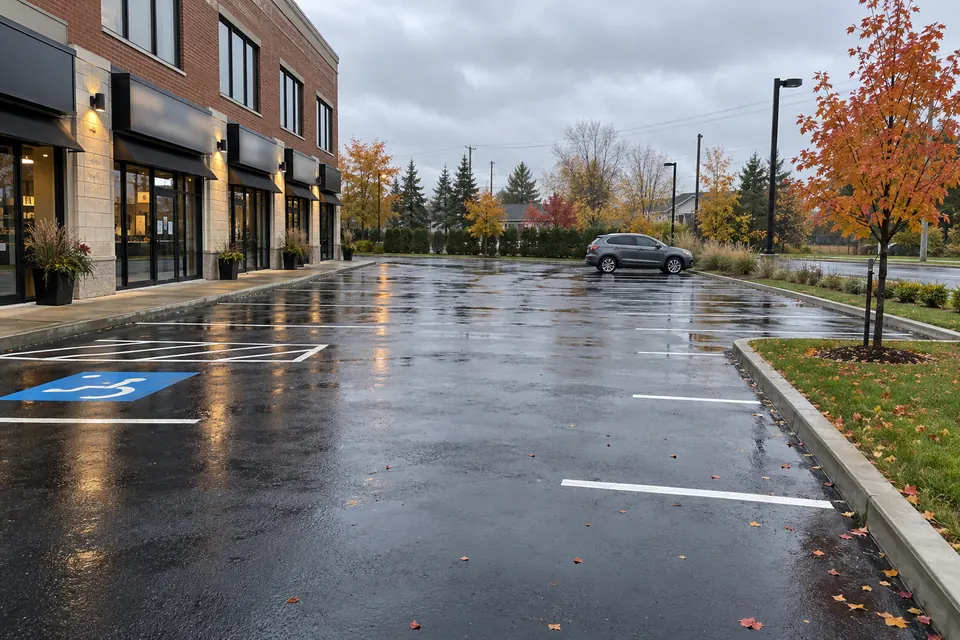
Parking lots · businesses, buildings, warehouses
Commercial parking lot paving: the right thickness for your trucks, zone by zone, without closing
A business or apartment parking lot carries more weight than a driveway: for the driveway access of a business or apartment building, Gatineau calls for 80 mm of asphalt, versus 50 mm for a house. We size the asphalt and the stone to your vehicles, sort out the water at the catch basins and pave zone by zone to keep your entrances open.
- Free quoteWe come take a look, no obligation.
- Clear priceEvery step spelled out in the quote.
- Hot asphaltLaid with a paver, rolled.
- Quick callbackThe owner, not a salesperson.
On this page
Paving a commercial parking lot means building a pavement: a base and an asphalt mix sized for delivery trucks, buses or forklifts, grades that take every drop of water to the catch basins, then the stall markings. The price depends on the area, the condition of the base and the load; that is why a parking lot is priced after an on-site survey, not by a square-foot figure read online.
- Thickness: Gatineau’s 2026 specifications call for 80 mm of asphalt on the driveway access of a business or apartment building; that is a benchmark, and the lot itself is sized to its real traffic, in two lifts where trucks run.
- Work: zone by zone, early morning, overnight or on weekends, with a phasing plan handed over before day one.
- Striping: about $13 per standard stall and $65 per accessible stall (Groupe Soli, 2026).
- Maintenance: cracks hot-sealed with $250–400 below 200 linear feet, sealcoat quoted by area.
Repair, resurface or rebuild a parking lot
| Condition of the lot | What we propose | Closure |
|---|---|---|
| Isolated cracks, surface still tight | Hot crack sealing | A few hours per zone |
| Potholes and sunken catch basins, rest sound | Hot-mix repairs, catch basins reset | A day or a night |
| Grey, porous surface everywhere, sound base | Edge milling and a 50–80 mm overlay | One zone per day or night |
| Alligator cracking in the aisles, truck ruts | Rebuild of the heavy-traffic zones | In phases, per the plan |
| Water that ponds and ices in winter | Grades corrected, catch basins or drains added | Built into the phases |
An overlay is only worth it if the base carries the load: a layer laid on a base that flexes under trucks gets its ruts back within a few seasons. Our asphalt resurfacing page explains the test.
A free survey of your parking lot, then the options and their price
Thickness for what drives on your lot
Québec’s transport ministry classifies mixes by traffic. Its mix selection criteria (December 2024) give the laying thicknesses of each mix:
| Mix | Role | Planned laying thicknesses |
|---|---|---|
| MUN-10 | Surface, traffic under 2,000 vehicles a day | 40, 50 or 60 mm |
| ESG-10 | Surface | 40, 60 or 70 mm |
| ESG-14 | Single layer | 60, 70 or 80 mm |
| GB-20 | Base course | 80, 100 or 120 mm |
In practice:
- Apartment, clinic or office lot: mostly cars; about 80 mm of asphalt on compacted stone, the thickness Gatineau requires for the driveway access of a business or apartment building.
- Delivery lanes, loading docks, bus areas: a base course and a surface course, and a thicker stone base; these are the zones to rebuild first.
- Truck or warehouse yard: a harder bitumen and coarser aggregate, as CAA-Québec already recommends for a truck parked full-time in a driveway.
Keeping the business open during the work
- A zone plan. We divide the lot into zones that always leave an entrance, an exit and some stalls open, and hand you the phasing plan with dates.
- The right hours. Milling and paving early in the morning, overnight or on weekends, depending on your opening hours and your city’s noise rules.
- Tenants told in advance. A notice ready to post or send, with the closed zones, the hours and where to park.
- Zones back in service fast. A paved zone reopens to cars as soon as the mix has cooled; the ministry opens a road once the mix is below 45 °C through its depth.
- Striping last. Lines go down on mix that has cured enough, often on a final night.
The full sequence is in our guide to paving a parking lot without closing.
Water: catch basins, grades and ice
In a parking lot, water that doesn’t drain becomes ice in winter and a pothole in spring. A survey settles three things before paving:
- Catch basins: one sitting too high holds water around it, one that has sunk creates a dip that breaks the asphalt. We reset them to the new surface.
- Grades: every zone has to drain to a catch basin or the street, with no puddle left after rain.
- Snow: the spot where the plough piles snow melts all spring; we point it toward a catch basin or a green area.
Curbs, striping and accessories
- Striping: stalls, arrows, crosswalks and accessible stalls, at about $13 per standard stall and $65 per accessible stall (Groupe Soli, 2026).
- Concrete or asphalt curbs repaired or added along islands and lawns.
- Wheel stops reset after paving.
- Repairs around manholes and light pole bases.
What our survey includes
- A plan of the lot and the area of each zone.
- The condition of the surface, and the base probed where it flexes.
- Grades, catch basins and icing spots mapped.
- Priced options: repair, resurface or rebuild, zone by zone.
- A phasing plan and schedule.
For a condo board or a property manager, this survey feeds the maintenance log and contingency fund planning: see our page on condo, apartment and business parking lots.
Frequently asked questions
How much does commercial parking lot paving cost?
It is priced after a survey: the area, the condition of the base, the thickness your vehicles need and the phasing change everything. Per-square-foot prices on aggregator sites, $3 to $10/ft², say nothing about a specific lot. Striping is extra, at about $13 a stall.
How thick should a commercial parking lot’s asphalt be?
About 80 mm of asphalt for a car lot at a business or apartment building: that is what Gatineau’s 2026 specifications set for their driveway access, a benchmark rather than a rule for the whole lot. Truck and delivery lanes need a base course and a surface course, on a thicker stone base.
Can you pave at night or on weekends?
Yes, depending on your site and your city’s noise rules. We schedule milling and paving at the least disruptive hours, and the schedule is in the phasing plan handed over before the work.
How long does a parking lot stay closed?
One zone at a time, rarely more than a day or a night each. A paved zone reopens to cars as soon as the mix has cooled; striping is done last, often in one night.
Do you stripe the stalls?
Yes, in the same quote: stalls, arrows, crosswalks and accessible stalls, painted on mix that has cured enough.
Do you offer yearly parking lot maintenance?
Yes: a spring inspection, hot-sealed cracks, potholes rebuilt with hot mix and sealcoat every few years, planned around your budget.
Where do you work?
The crew is based in Montréal and takes on parking lots across Québec, first in Montréal, Laval, the North Shore, Lanaudière and the South Shore. See the service areas or use the request form.
Sources
- City of Gatineau, standard specifications « Enrobés » (January 2026): residential and commercial driveway-access thicknesses (table 8).
- Québec transport ministry, Critères de sélection des enrobés (December 2024): laying thicknesses and use of MUN-10.
- Québec transport ministry, Guide technique sur la mise en place des enrobés bitumineux (2009): opening to traffic.
- CAA-Québec and Bitume Québec, technical sheet on the asphalt driveway (heavy vehicles).
- Groupe Soli, 2026 striping rates; Soumission Rénovation, commercial prices (May 2026); compiled on our price page.
2026 prices in detail: sources and calculator.
Commercial paving: in your city.
Montréal and Laval
North Shore
Les Moulins and Lanaudière
South Shore
Montérégie
Québec City region
Eastern Townships
Mauricie and Centre-du-Québec
Outaouais
Saguenay–Lac-Saint-Jean
Eastern Québec
Go further.
Redoing a parking lot without closing: the phasing plan, night by night
How we repave a business or apartment parking lot while keeping customers and tenants: a sample four-night plan for 60 stalls, paving temperatures, reopening, striping and notices.
ReadYour building’s parking lot, priced for your budget and redone without closing.
For condo boards, property managers and businesses: a priced condition survey of your parking lot for the maintenance log and contingency fund (Bill 16), zone-by-zone work, one point of contact.
Read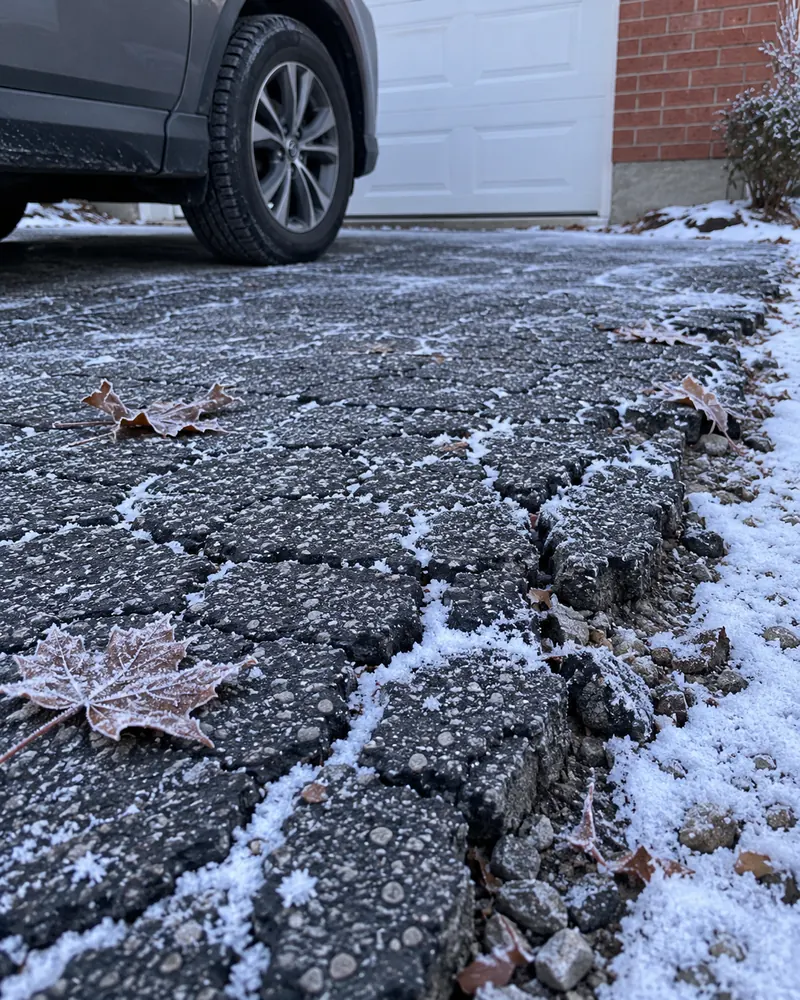
Your asphalt driveway and winter: what to do in October, in January and at the thaw
What to do for your asphalt driveway before the snow, during winter and at the thaw: cracks to close before the freeze, markers, de-icers, the plough blade, Tempo shelters and heavy trucks in spring.
ReadBefore the freeze, not next spring.
Describe your project in two minutes. We call you back quickly, come take a look and you get your price, free.