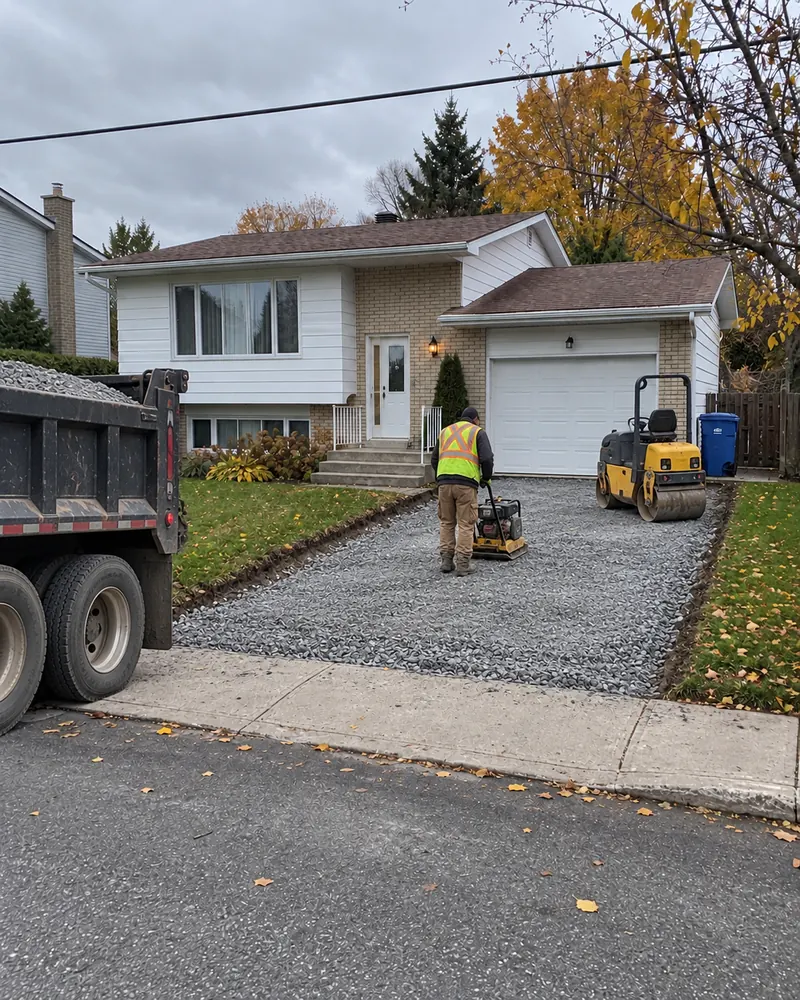
Excavation · stone base · drainage
Excavation and base: the depth and the stone that decide your winters
Under a driveway that lasts, there are 30 to 45 cm of soil replaced in sand, 45 cm or more in clay, MG-20 stone compacted in lifts and a slope that takes water to the street. Excavation and the base are included in a rebuilt driveway, at $6–10/ft² in 2026.
- Free quoteWe come take a look, no obligation.
- Clear priceEvery step spelled out in the quote.
- Hot asphaltLaid with a paver, rolled.
- Quick callbackThe owner, not a salesperson.
On this page
A driveway’s base is the layer of compacted crushed stone that carries the asphalt and spreads the cars’ weight over the soil. In Québec it has a second job: staying dry and stable while the ground freezes, 1.2 m to more than 3 m deep depending on the region, then thaws from the top down in spring. A base that is too thin, poorly compacted or holds water makes the asphalt ripple, crack and sink, whatever the quality of the mix laid on it.
- Depth: 30–45 cm in draining sand, 45 cm or more in poorly drained clay (CAA-Québec).
- Stone: MG-20 (0–¾ in), compacted in lifts to 95% of its maximum dry density, Laval’s standard for private driveways.
- Drainage: a slope of at least 2% toward the street, geotextile fabric over clay, a drain if the water has nowhere to go.
- Price: included in a rebuilt driveway, $6–10/ft² in 2026; the depth to dig is what moves the price most.
Why Québec soil needs a real base
Much of the St. Lawrence plain, from Montréal to Québec City, sits on clays left by the ancient Champlain Sea. These soils hold water and swell when it freezes: they are frost-susceptible. The transport ministry describes what happens next at the thaw: the pavement thaws from the top, meltwater stays trapped above the still-frozen ground, and the pavement keeps only 30 to 70% of its summer strength.
Crushed stone solves both problems at once. It lets water drain down and away instead of holding it, and it puts distance between the asphalt and the frost-susceptible soil. The more clay and the poorer the drainage, the more thickness is needed between the two.
| Soil found when digging | What it does in winter | What we build |
|---|---|---|
| Draining sand or gravel | Little heaving | 30–45 cm of excavation, compacted MG-20 stone |
| Silt or fill | Holds water, heaves in spots | Dug to firm soil, thicker stone |
| Grey or blue clay, wet | Swells when frozen, softens at the thaw | 45 cm or more, geotextile, careful slope and drainage |
| Old packed gravel driveway | Varies: often too thin | Gravel probed; topped up or replaced |
| Topsoil, roots, debris | Decays and settles | All removed down to native soil |
The base, layer by layer
| Step | What we do | The benchmark |
|---|---|---|
| Locate | Info-Excavation request for buried lines | Free, at least 3 business days before digging |
| Excavation | Old surface, topsoil and soft soil removed | Down to firm native soil; depth by soil type |
| Subgrade | Bottom graded to the final slope, compacted | At least 2% toward the street |
| Geotextile | Fabric laid over clay or silt | Keeps fine soil from pumping up into the stone |
| Sub-base, if needed | Coarser stone where a lot of thickness is needed | Sub-base materials, ministry standard 2102 |
| Base | MG-20 stone spread in thin lifts, each one compacted | 95% of maximum dry density (Laval) |
| Width | Stone wider than the asphalt | 30 cm extra on each side (CAA-Québec) |
| Check | Grades and slopes checked before the asphalt | Water has to run off, not pool |
Compacting in lifts is the step you can’t make up for later: stone dumped 30 cm deep in one go and rolled once stays loose at the bottom. CAA-Québec calls for two lifts beyond 30 cm; we compact lifts of 150 mm at most. Stone that extends past the asphalt on each side supports the edge, which otherwise crumbles under tires and under the snow pushed onto it.
What soil is under your driveway? We probe it for free before giving you a price
Signs of a failed base
- A ripple or dip that holds water after rain.
- Alligator cracking, a web of small pieces, where the wheels run.
- A bump that comes back every winter, then settles in spring.
- Edges crumbling over the first 60 centimetres.
- Cracks that come through a resurfacing in its first years.
None of these can be fixed from the top. Neither sealer nor a new layer rebuilds the stone: it has to be dug out and rebuilt, in full or where the damage is. Our article resurfacing or rebuilding explains the test that decides between the two.
Drainage: water has to get out of the stone
A base only stays stable if water doesn’t build up in it. While we dig, we also look at what happens around the driveway:
- Downspouts that empty onto the asphalt: we extend them or redirect them to the lawn.
- Driveways that slope down to the garage: a channel drain in front of the door, connected according to the city’s rules.
- A neighbour’s higher lot: a slope or swale that keeps water out of the base.
- The snow pile that melts in the same spot all spring: we mark it on the plan, so it melts toward the street.
Excavation for other projects
We also dig and prepare the base for driveway widenings, business or apartment parking lots, ground that will receive pavers, or a shelter slab. Commercial lots need more: Gatineau’s 2026 specifications call for 80 mm of asphalt on the driveway access of a business or apartment building, versus 50 mm for a house, and the base follows. See our commercial paving page.
What your quote should spell out
- The excavation depth and what comes out (asphalt, concrete, soil, roots).
- The type of stone, its compacted thickness and the number of lifts.
- Geotextile fabric, if there is clay.
- The final slope and where the water will go.
- Hauling of debris, included or not.
A quote that gives none of these measurements sells a price per square foot, not a base. The guide on how to choose a paving contractor has the questions to ask.
Frequently asked questions
How deep should you dig for an asphalt driveway?
30 to 45 cm (12 to 18 in) in draining sandy soil, and 45 cm (18 in) or more in poorly drained clay, according to the CAA-Québec and Bitume Québec technical sheet. We dig down to firm native soil.
What stone goes under an asphalt driveway?
MG-20 crushed stone (0–¾ in), compacted in lifts. The City of Laval requires 300 mm of MG-20 at 95% of maximum dry density when it rebuilds a private driveway.
Is geotextile fabric needed?
On clay or silt, yes: it keeps fine soil from pumping up into the stone and making it frost-susceptible. On clean draining sand, it usually isn’t needed.
How much does driveway excavation cost?
It is included in the price of a rebuilt driveway, $6–10/ft² in 2026, along with the stone and the asphalt. Clay that needs 45 cm or more, or an old concrete slab to remove, puts a project at the top of the range.
How long do excavation and the base take?
One day for a house driveway: saw cuts, excavation, fabric, stone compacted in lifts. The asphalt goes down the next day, or within the following days.
Do I need a permit to dig out my driveway?
Not to redo a driveway to the same dimensions in most suburban cities. You need one to widen it or touch the curb, and an Info-Excavation locate is always requested before digging. Each city’s rules are in our permit guide.
Sources
- CAA-Québec and Bitume Québec, technical sheet on the residential asphalt driveway (2011): depths by soil type, MG-20, two lifts beyond 30 cm, geotextile, stone width, slope.
- City of Laval, special specifications for road infrastructure (V3/R1, September 2023), private driveway restoration.
- Québec transport ministry, En période de dégel, roulez léger (2026): frost depth, loss of strength at the thaw.
- Québec transport ministry, standard 2102, granular base and sub-base materials.
- City of Gatineau, standard specifications « Enrobés » (January 2026), residential and commercial driveway-access thicknesses.
- Info-Excavation, locate request.
- Federal Highway Administration, Distress Identification Manual (alligator cracking, edges).
Excavation and foundation: in your city.
Montréal and Laval
North Shore
Les Moulins and Lanaudière
South Shore
Montérégie
Québec City region
Eastern Townships
Mauricie and Centre-du-Québec
Outaouais
Saguenay–Lac-Saint-Jean
Eastern Québec
Go further.
Resurfacing or rebuilding: the five-step test to find out what your driveway needs
Overlay or redo your driveway? The 3 m straightedge test, reading the cracks, probing the edge, the cost per year of each option and the combined fix that often costs least.
Read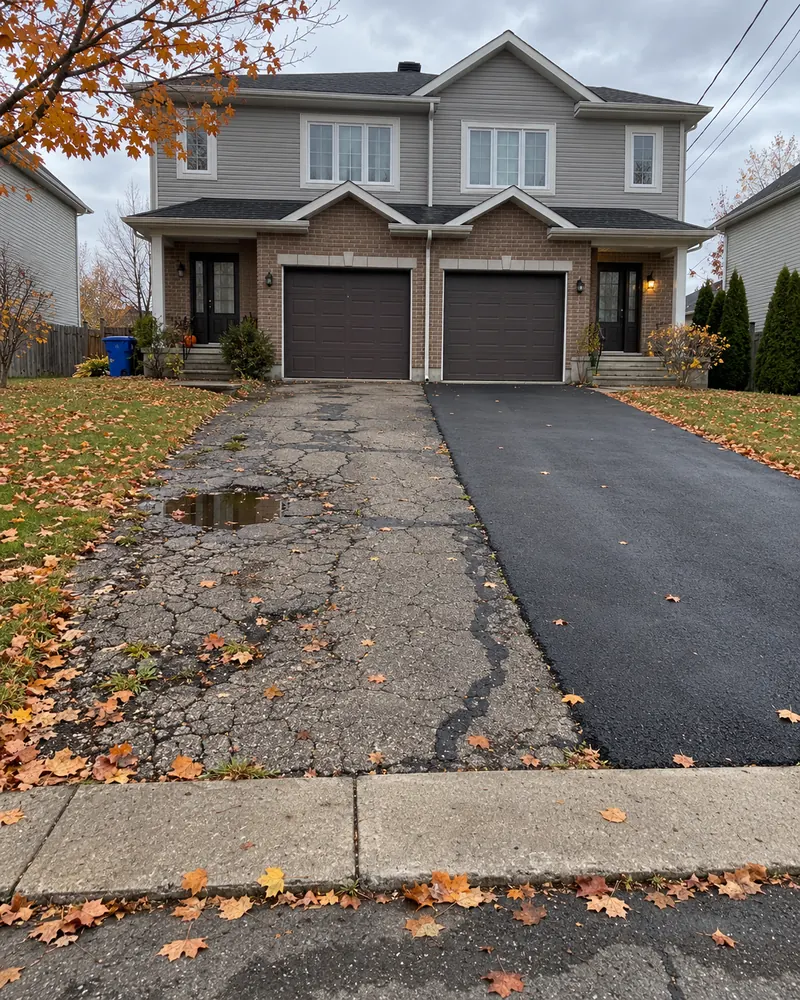
How many years does an asphalt driveway last in Quebec?
Built right, an asphalt driveway lasts 15 to 20 years or more in Quebec. The 6 benchmarks to demand, how to read the damage, and the cost per year of each fix.
Read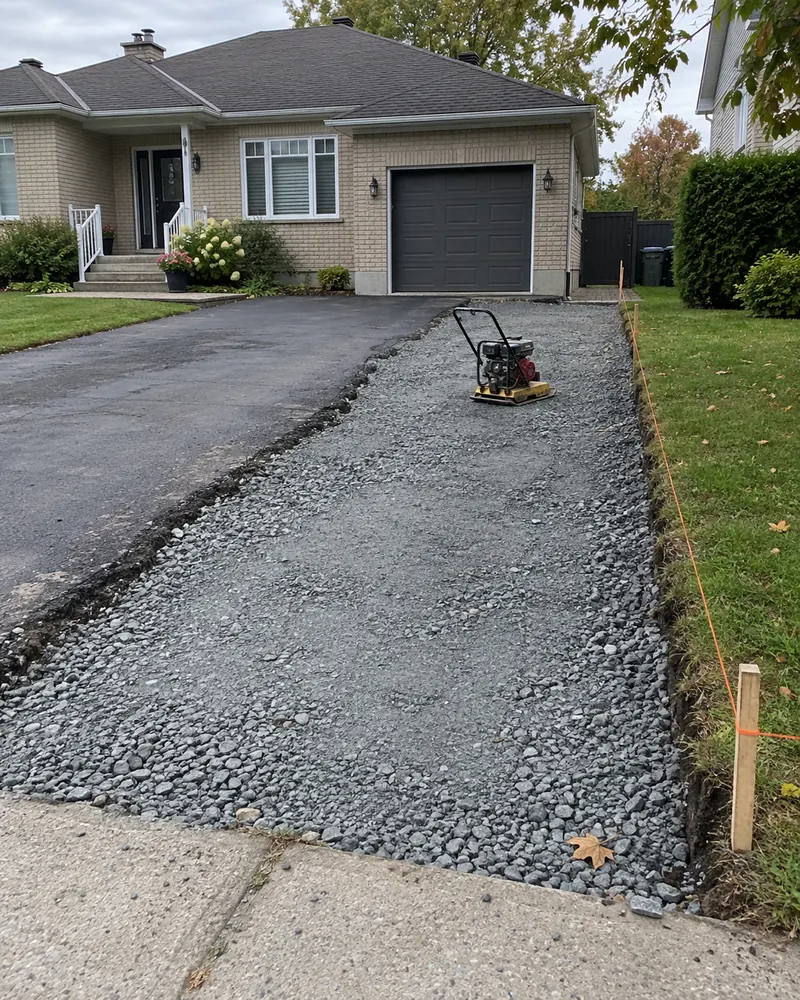
Driveway permits: what 16 cities require (rules checked in 2026)
Repaving as is, gravel to asphalt, widening: what Laval, Terrebonne, Longueuil, Brossard and 12 other cities require. Widths, curb cuts, fees and deadlines.
ReadBefore the freeze, not next spring.
Describe your project in two minutes. We call you back quickly, come take a look and you get your price, free.