Paving advice · Lifespan
How many years does an asphalt driveway last in Quebec?
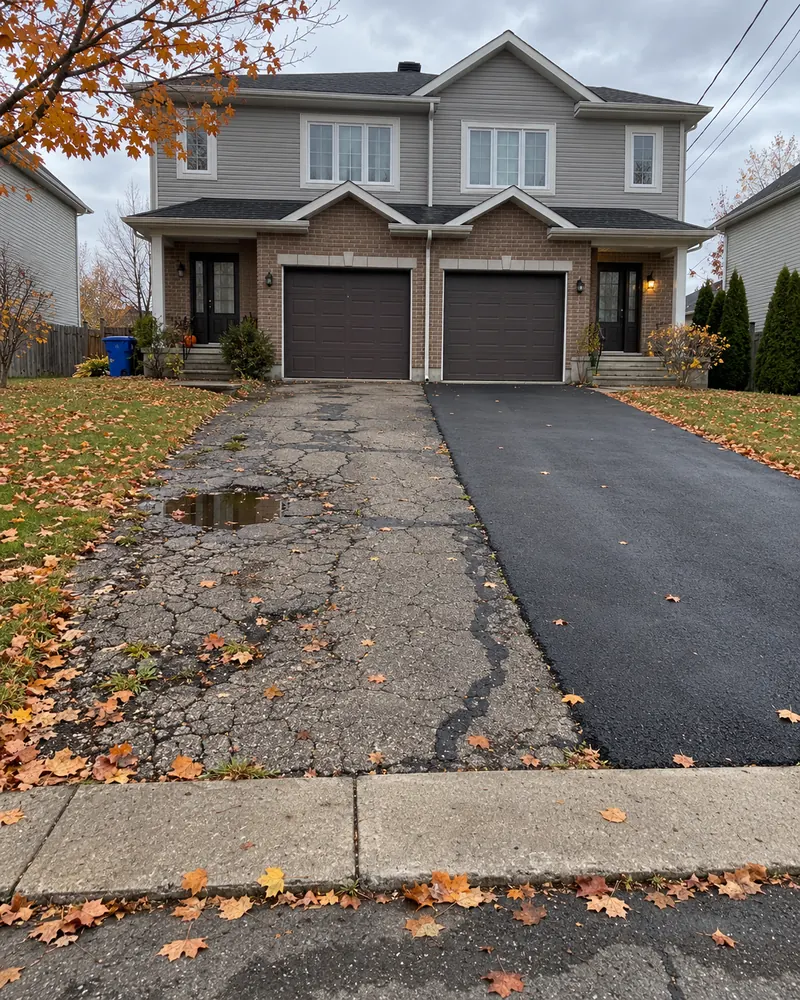
15 to 20 years, and more than 20 when the base is done right. In Quebec, that number is decided below the surface: the compacted stone, the asphalt thickness, the density the roller leaves behind and the slope. Here are the benchmarks to check, how to read the damage, and the fix that costs the least per year of service.
- Free quoteWe come take a look, no obligation.
- Clear priceEvery step spelled out in the quote.
- Hot asphaltLaid with a paver, rolled.
- Quick callbackThe owner, not a salesperson.
On this page
- The short answer
- What credible sources say
- Why Quebec winters set the number of years
- The six benchmarks that make a new driveway last
- Reading your driveway: what each kind of damage tells you
- What extends the life of an existing driveway
- Repair, resurface or rebuild: the cost per year of service
- What we check during the free visit
- Frequently asked questions
- Sources (consulted October 24–26, 2026)
The short answer
- 15 to 20 years on average, according to the National Association of Home Builders study on the service life of home components.
- More than 20 years when the stone base, the asphalt thickness and the drainage are done right: that is the target in CAA-Québec’s technical sheet, prepared with Bitume Québec.
- Only a few winters when the stone is missing or was never compacted, the two most common reasons asphalt deforms or tears, according to the same sheet.
- 10 to 15 more years from a resurfacing laid over a base that is still sound (Protégez-Vous and the APCHQ, Quebec’s home builders’ association).
- The maintenance step that pays the most: closing 3–20 mm cracks soon after they appear, and never letting water sit.
- In dollars: a fully rebuilt double driveway ($2,400–4,000 before tax in 2026) works out to about $120–270 per year of service.
What credible sources say
No reliable source gives a number of years without conditions: each one ties the lifespan to how the driveway was built and maintained.
| Source | Stated lifespan | Condition |
|---|---|---|
| CAA-Québec, with Bitume Québec (2011) | more than 20 years | a quality granular base, enough asphalt thickness, effective drainage |
| Protégez-Vous (2023) | up to 20 years | well-maintained asphalt |
| La Presse (2020) | “easily 20 years” | a well-done paving job |
| Asphalt associations of Ontario (2004), Colorado (2005, 2020) and Wisconsin | up to 20 years of virtually trouble-free service | a properly designed, built and maintained driveway |
| NAHB and Bank of America (2007) | 15 to 20 years | average life of an asphalt driveway |
| Protégez-Vous and APCHQ (2023) | 10 to 15 more years after resurfacing | old asphalt without major cracks, dips or bumps |
These lifespans add up when the stone holds: 15 to 20 years for the first surface, then 10 to 15 years for a resurfacing laid in time, or 25 to 35 years on the same base. A failed base, on the other hand, can only be fixed by excavating again.
Why Quebec winters set the number of years
In Quebec, a driveway wears out less under tires than from water freezing in and under the asphalt, then from a waterlogged base in spring.
- Deep frost. According to Quebec’s Ministry of Transportation, the ground freezes for more than four months a year, from 1.2 m to more than 3 m deep depending on the region, and temperatures sometimes swing by 25 °C within a few hours.
- The thaw. The base thaws from the top while the deeper soil stays frozen: meltwater is trapped, and a road keeps only 30 to 70% of its summer strength. Hence the load limits on trucks, which started on March 16 in 2026 in zone 1, the zone that covers Montréal.
- The cold. Asphalt stiffens and shrinks until it snaps into transverse cracks. Frost heave opens other cracks, zigzagging and wider in winter than in summer, which the ministry calls lézardes.
- A binder chosen for this climate. Residential asphalt is about 94% aggregate and 6% bitumen, most often a PG 58-28: a binder graded for pavement that reaches 58 °C in summer and drops to −28 °C in winter. In the province’s colder zones, the ministry moves to binders graded for −34 °C and −40 °C.
The number of crossings below and above 0 °C changes from town to town. From Environment Canada’s climate normals, here are the average freeze-thaw days in the areas we serve:
| Area | Station | Freeze-thaw days per year | Of which in November |
|---|---|---|---|
| Longueuil, Brossard | Saint-Hubert | 85.0 | 15.5 |
| Mirabel | Mirabel | 84.5 | 17.2 |
| L’Assomption, Repentigny | L’Assomption | 83.0 | 16.6 |
| Sainte-Thérèse, Blainville, Rosemère, Boisbriand, Bois-des-Filion, Lorraine | Sainte-Thérèse Ouest | 82.3 | 16.2 |
| Terrebonne, Mascouche, east end of Montréal island | Rivière-des-Prairies | 81.9 | 16.3 |
| Montréal, Laval | Montréal-Trudeau | 73.5 | 14.8 |
| Saint-Eustache | Sainte-Geneviève | 67.2 | 13.8 |
The practical consequence: no heavy loads on the driveway during the thaw. From 2021 to 2025, the zone 1 restrictions lasted 39 to 46 days, between early March and early May. A moving truck, a dumpster or a cement mixer manoeuvring on a waterlogged base leaves ruts that summer won’t erase.
The six benchmarks that make a new driveway last
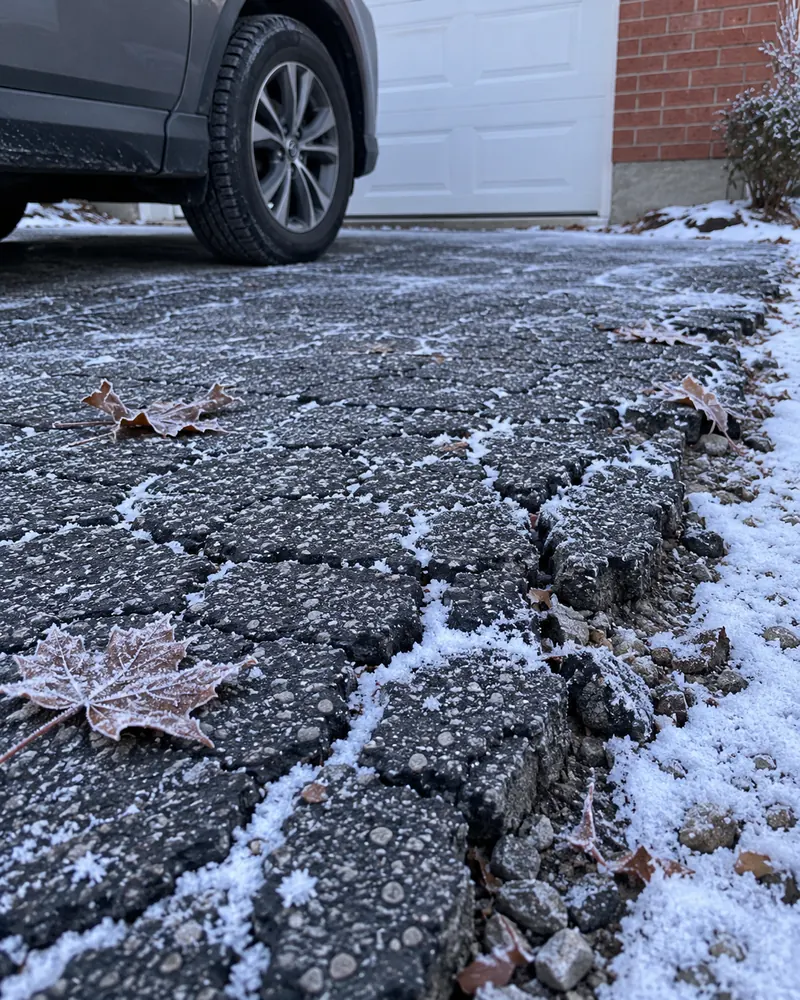
Six numbers, all checkable before you sign, separate a driveway that gets through 20 winters from one that turns wavy after a few.
| Benchmark | What to aim for | Source |
|---|---|---|
| Excavation depth | 30–45 cm (12–18 in) in sandy, free-draining soil; 45 cm (18 in) or more in poorly drained clay | CAA-Québec |
| Stone base | MG-20 (0–¾ in), compacted in two lifts when thicker than 30 cm, extending at least 30 cm past the asphalt on each side; geotextile membrane over clay | CAA-Québec |
| Stone density | at least 95% of its maximum dry density, over 300 mm | City of Laval, private driveway restoration |
| Asphalt thickness | 60–75 mm (2½–3 in) laid down, for at least 50 mm (2 in) compacted everywhere; for more durability, a 50 mm base course and a 40 mm surface course | CAA-Québec; OHMPA |
| Asphalt density | at least 93% of the mix’s maximum density, or about 7% air voids | City of Laval |
| Slope | at least 2%, or ¼ in per foot, toward the street | CAA-Québec; OHMPA |
Asphalt density is the least known benchmark, and one of the most important. A 1989 Transportation Research Board study, based in part on pavements tracked by Washington State, draws a rule from it: every percentage point of air voids above 7% takes away about 10% of pavement life, or roughly two years per point on a driveway meant to last 20. That density is won in the minutes after laying: the mix must be compacted before it cools below 85 °C (Asphalt Institute), and a thin layer spread over a cool surface may leave only 10 to 20 minutes of effective rolling (Colorado Asphalt Pavement Association).
What is also decided on the day of the job:
- Over 50 mm, two lifts. No more than 50 mm of compacted asphalt in a single pass (OHMPA).
- A new house waits. CAA-Québec advises letting the ground settle for 6 to 12 months before paving.
- Supported edges. Curbs or blocks along the asphalt keep it from cracking along its sides (CAA-Québec).
- The right temperature. Mix giving off blue smoke is overheated: it may ravel and harden too early. Too cold, it won’t compact and leaves a porous finish that lets water in (OHMPA; CAA-Québec).
- A heavy vehicle calls for a harder mix. For a truck or RV parked regularly, CAA-Québec recommends a mix with larger aggregate or a PG 64-28 binder.
Ask for these numbers in every quote you compare: excavation depth, stone thickness, compacted asphalt thickness and slope. Our excavation and foundation page shows how we prepare the base, our asphalt driveway paving service follows these benchmarks, and the guide on how to choose a paving contractor lists the questions that bring these numbers out.
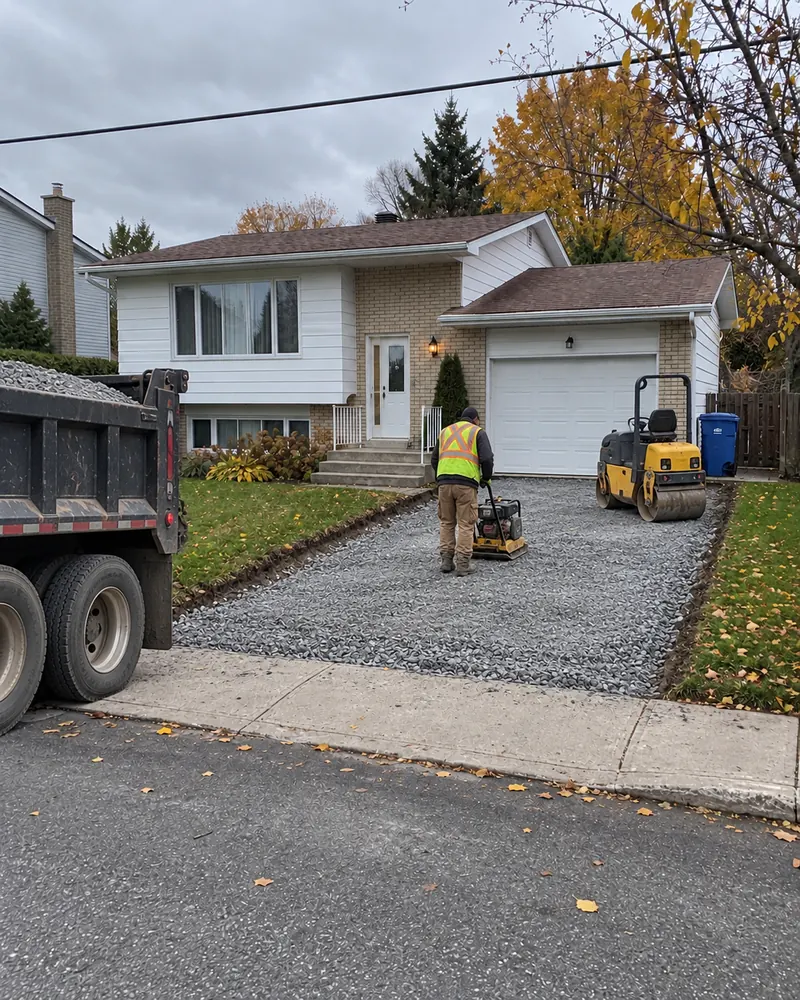
A driveway built to these six benchmarks: your price after a free visit
Reading your driveway: what each kind of damage tells you
The shape of the damage says more about a driveway’s future than the year it was paved. Walk around it after a rain, with a ruler marked in millimetres.
| What you see | What it means | What fixes it |
|---|---|---|
| Grey, rough surface, stones coming loose | the surface binder has aged; the structure often holds | a sealer if nothing is sinking, a resurfacing if the wear covers the whole driveway |
| Fine crack, under 3 mm | early cold shrinkage of the asphalt | too narrow for a product to get in: keep an eye on it |
| Single crack, 3–20 mm | cold shrinkage, ageing | hot-poured crack sealing, $250–400 below 200 linear feet |
| Crack over 20 mm with broken edges | a crack that has been working for several winters | cut out and repaired with hot asphalt |
| Zigzag crack that opens much more in winter | frost in frost-susceptible soil or unstable fill | no sealing, which would tear: the base or drainage gets corrected at that spot |
| Network of cracks in pieces under 30 cm (“alligator skin”) | fatigue: the base no longer carries the load | rebuild the area with its base, or the whole driveway |
| Crescent cracks or a crumbling edge, within 60 cm of the side | no lateral support | edge rebuilt on compacted stone |
| Puddle that stays, low spot in front of the garage | settled or washed-out base | local base correction, or a rebuild |
| Pothole, severe beyond 50 mm deep | water and tires have torn out the asphalt | clean cut, base recompacted, hot asphalt: quoted by area and depth |
The 3 and 20 mm thresholds are the ones Quebec’s Ministry of Transportation uses to choose which cracks to seal. The ministry also refuses to seal alligator cracking, a sign of insufficient bearing capacity, and frost cracks whose opening varies by more than 5 mm between summer and winter, because the sealant tears in the cold. The piece size, the 60 cm edge band and the pothole depth come from the Federal Highway Administration’s distress identification manual. Frost cracks, alligator cracking, crumbling edges and low spots point to the base: neither sealer nor a new layer fixes them for good.
Not sure what you’re looking at? A first read in 2 minutes, then a free visit
What extends the life of an existing driveway
Closing cracks at the right time buys more years than any product spread over the whole surface.
- Spot them at the end of winter, seal them in season. The ministry surveys cracks at the end of winter, while the frost cracks are still visible, then seals them between May 15 and mid-October, at 5 to 30 °C, soon after they appear: earlier in spring, they are still too damp. In November, the average daily high is still 4.7 to 6.1 °C depending on the station: some dry afternoons clear that 5 °C threshold, and it is the last chance to close a crack before water freezes in it all winter. Our asphalt repair service closes cracks with hot sealant, before they turn into potholes.
- Keep water moving. Extend a downspout that empties onto the asphalt, get a low spot fixed as soon as it holds water, and move the snowbank that melts in the same corner all spring.
- Spread the loads. Plywood under a trailer’s tongue jack or an RV’s stabilizer jacks, and wheels kept away from an unsupported edge (Wisconsin Asphalt Pavement Association).
- Clean up leaks. Gasoline, antifreeze, oil and transmission fluid break down the binder; soapy water or absorbent kitty litter does the job if you act quickly (same source).
- Seal the surface when it greys, not before. Sealer shields the surface from sun, water and vehicle fluids, without adding any strength. The Asphalt Institute expects none on a well-built driveway for 2 to 5 years, and the Colorado asphalt association then renews it every 2 to 5 years. The details are in is asphalt sealing worth it?
- Go easy on new asphalt. Keep the car off the driveway for 2 to 3 days, longer in a heat wave, and heavy trucks much longer. Don’t turn the steering wheel while stopped: tire marks show up mostly in the first year, in high heat or during the thaw, and most fade over time (WAPA).
- Anchor the winter shelter without punching new holes every fall. Permanent anchors drilled once into sound asphalt replace stakes driven in again every season, which leave holes where water freezes. Tempo shelter installation: single $199, double $299 before taxes; $329 and $449 with spring removal. See our prices and prices published elsewhere.
Cracks to close before they widen: we’ll come and look for free
Repair, resurface or rebuild: the cost per year of service
The most economical fix is the one that costs the least per year of service, not the one with the smallest bill today.
| For a 400 ft² double driveway | 2026 price, before tax | Stated lifespan | Cost per year |
|---|---|---|---|
| Hot-pouring 50 ft of cracks | $250–400 published visit package | Road-treatment study; driveway outcome varies | Compare the full visit cost |
| Resurfacing over a sound base | $1,200–2,200 | 10 to 15 more years (Protégez-Vous and APCHQ) | about $80–220 |
| Fully rebuilt driveway | $2,400–4,000 | 15 to 20 years and more (NAHB; CAA-Québec) | about $120–270 |
Calculation: the area contractors’ 2026 prices, divided by the years each source gives. Detailed prices and the calculator are on our 2026 asphalt paving prices page.
Resurfacing only wins on a sound base. The Ontario hot mix producers’ association warns that unrepaired alligator cracking comes back through the new layer. Laid on a base that has failed, a $1,200–2,200 layer that lasts only 5 years costs $240–440 a year, more than a rebuilt driveway. Our article on resurfacing or rebuilding walks through the base test that decides between the two.
What we check during the free visit
The free visit answers one question first: does your driveway’s base still carry the load? We check the flatness under low-angle light, the width and shape of every crack, the asphalt thickness and the stone probed along an edge, the path water takes to the street, and the joints with the garage, the sidewalk and any paving stones.
You then get the fix that costs the least per year for your driveway: cracks to close, a resurfacing or a rebuild. Pavabris comes out to Montréal, Laval, the North Shore and the South Shore. The quote quiz takes 2 minutes: the age of the asphalt and what you see are enough for a first read. Include your preferred contact method in the form.
Frequently asked questions
How many years does an asphalt driveway last in Quebec?
A well-built asphalt driveway lasts 15 to 20 years in Quebec, and more than 20 years when the stone base, the asphalt thickness and the drainage are done to standard, according to CAA-Québec and Bitume Québec. A stone base that is too thin or poorly compacted can deform it within the first few winters.
How thick should the asphalt be for a driveway that lasts?
At least 50 mm (2 in) of compacted asphalt at every point, which means laying 60 to 75 mm. For a more durable driveway, the Ontario Hot Mix Producers Association recommends a 50 mm base course and a 40 mm surface course. Under the asphalt, the City of Laval puts down 300 mm of MG-20 stone, compacted to 95%, when it rebuilds a resident’s driveway.
How long does resurfacing last?
Laid over a sound base, a resurfacing can extend a driveway’s life by 10 to 15 years, according to Protégez-Vous and the APCHQ. The old asphalt must be free of major cracks, dips and bumps; otherwise, its defects come back up through the new layer.
Does sealer make a driveway last longer?
Sealer shields the surface from sun, water and vehicle fluids, but it adds no strength. For lifespan, closing 3–20 mm cracks matters more: on regional roads, Quebec’s Ministry of Transportation gets 4 to 8 years out of crack sealing.
How long should you wait before driving on a new driveway?
Plan on 2 to 3 days without a car, and longer in a heat wave; the Colorado Asphalt Pavement Association also recommends waiting a few days before opening a new driveway. Keep heavy trucks, such as a moving truck, off fresh asphalt, and don’t turn the steering wheel while stopped during the first year.
Why does a new driveway crack after two or three winters?
Most often, the stone base was too thin or poorly compacted, the two most common causes according to CAA-Québec, or the slope didn’t carry water away. On a new house, paving before the ground has settled, which takes 6 to 12 months, leads to the same result.
Does the law protect you if a driveway breaks down too fast?
Yes: in Quebec, the legal warranty requires installed asphalt to last a reasonable time given the price paid, the contract and the conditions of use, even if the contractor sold it “without warranty”. The law sets no number of years; the Office de la protection du consommateur gives the example of a driveway paved the year before that already has cracks or bulges.
Sources (consulted October 24–26, 2026)
- CAA-Québec, Fiche technique : asphaltage d’une entrée d’auto (driveway paving technical sheet, 2011; sources: Bitume Québec and the Office de la protection du consommateur).
- Protégez-Vous, Comment entretenir l’asphalte and Comment donner une deuxième vie à votre entrée en asphalte (August 15, 2023; the second comes from a guide produced with the APCHQ).
- La Presse, Pour un asphalte durable (June 26, 2020).
- Office de la protection du consommateur, Garanties prévues par la loi : asphalte et pavé (legal warranties for asphalt and pavers).
- Ministère des Transports et de la Mobilité durable: Document d’information sur le dégel (spring thaw information document, 2026 edition, with the 1991–2025 thaw history) and the March 12, 2026 zone 1 notice; Où et quand sceller les fissures d’un revêtement bitumineux ? (technical bulletin on crack sealing, vol. 8, no. 8, August 2003); Choix des composants, enrobés (asphalt mix components, December 2023).
- City of Laval, cahier des charges spéciales, construction et réhabilitation d’infrastructures routières, restoration of private works (300 mm of MG-20 at 95%, 50 mm of EC-10 PG 58S-28 at 93%).
- Environment and Climate Change Canada, climate normals: Montréal-Trudeau and L’Assomption (1991–2020); Saint-Hubert, Mirabel, Sainte-Thérèse Ouest, Rivière-des-Prairies and Sainte-Geneviève (1981–2010). Freeze-thaw days = days with a minimum at or below 0 °C, minus days with a maximum at or below 0 °C.
- Ontario Hot Mix Producers Association, The ABCs of Driveways (June 2004).
- Colorado Asphalt Pavement Association, Best Practices for the Use of Asphalt Driveways (November 2005) and Asphalt Driveways (March 2020); Wisconsin Asphalt Pavement Association, Driveway Owners Guide; Asphalt Institute, maintenance and rehabilitation FAQ.
- National Association of Home Builders and Bank of America Home Equity, Study of Life Expectancy of Home Components (February 2007).
- R. N. Linden, J. P. Mahoney and N. C. Jackson, Effect of Compaction on Asphalt Concrete Performance, Transportation Research Record 1217 (1989).
- Federal Highway Administration, Distress Identification Manual for the Long-Term Pavement Performance Program (FHWA-RD-03-031).
- 2026 prices: ranges published by Greater Montréal contractors, compiled on our asphalt paving prices page.
2026 prices in detail: sources and calculator.
Go further.
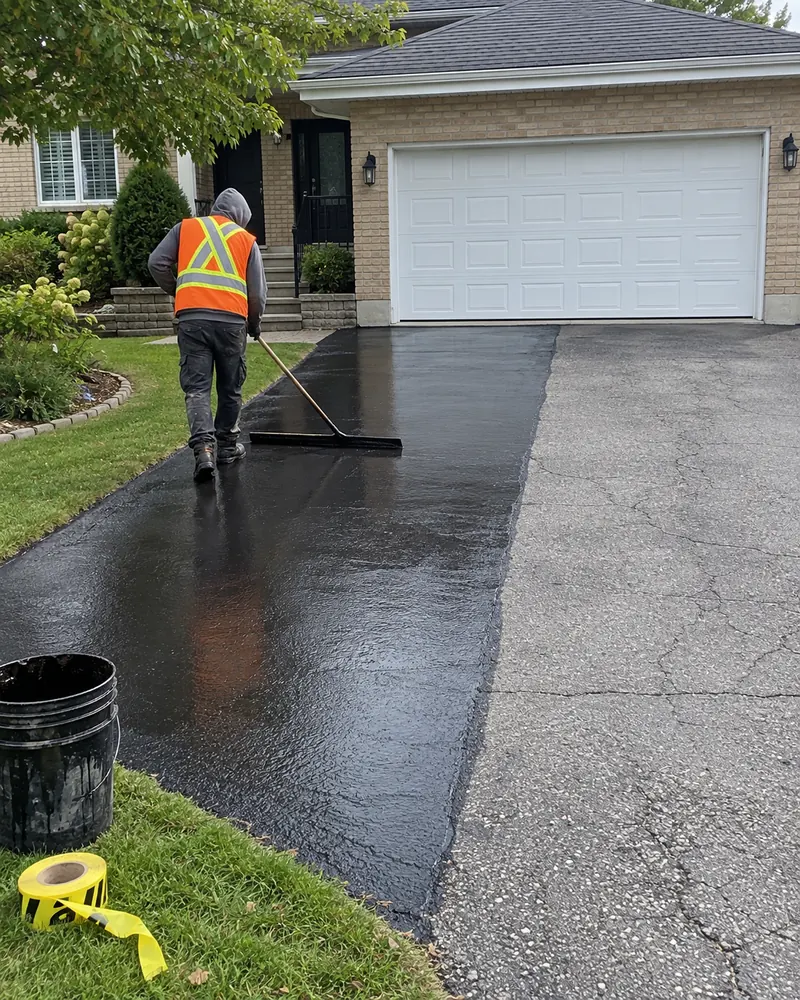
Is asphalt sealing worth it? What the evidence says
When asphalt sealer is useful, what it cannot fix, and how to compare preparation and prices. Contractor and DIY cost benchmarks for Québec driveways.
Read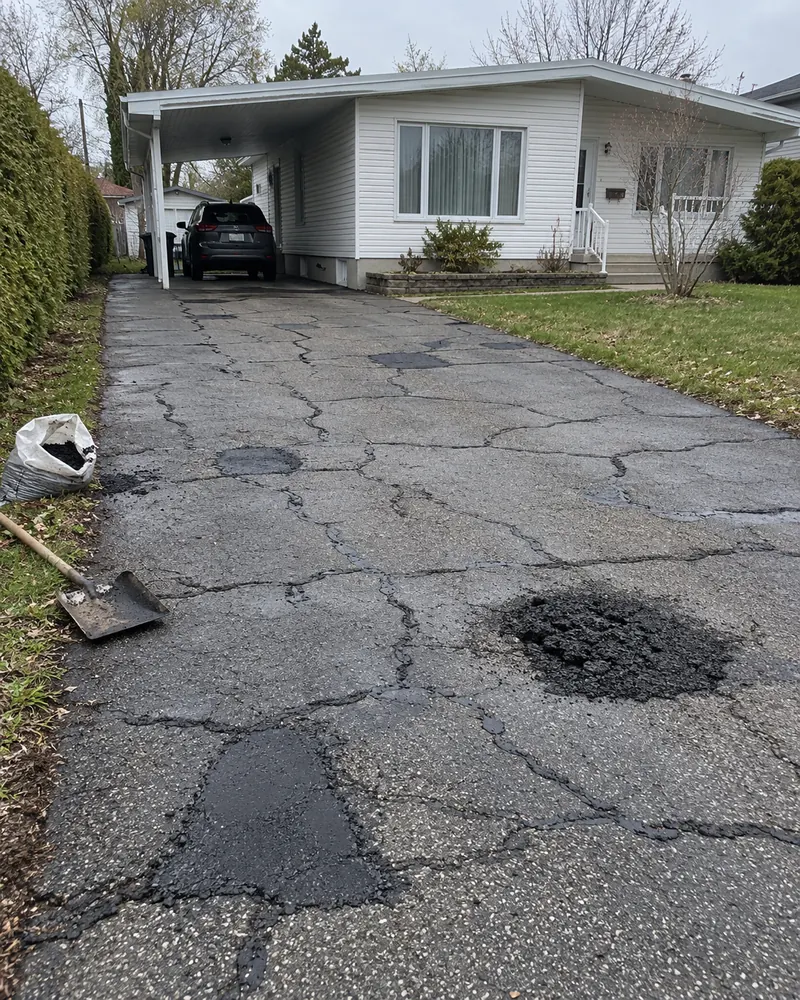
When to redo your asphalt driveway: seven signs ranked by urgency
Alligator cracking, dips that hold water, winter bumps, crumbling edges, potholes, a grey surface: what each sign means, what can’t wait until after winter and what it costs in 2026.
ReadYour asphalt driveway and winter: what to do in October, in January and at the thaw
What to do for your asphalt driveway before the snow, during winter and at the thaw: cracks to close before the freeze, markers, de-icers, the plough blade, Tempo shelters and heavy trucks in spring.
ReadBefore the freeze, not next spring.
Describe your project in two minutes. We call you back quickly, come take a look and you get your price, free.