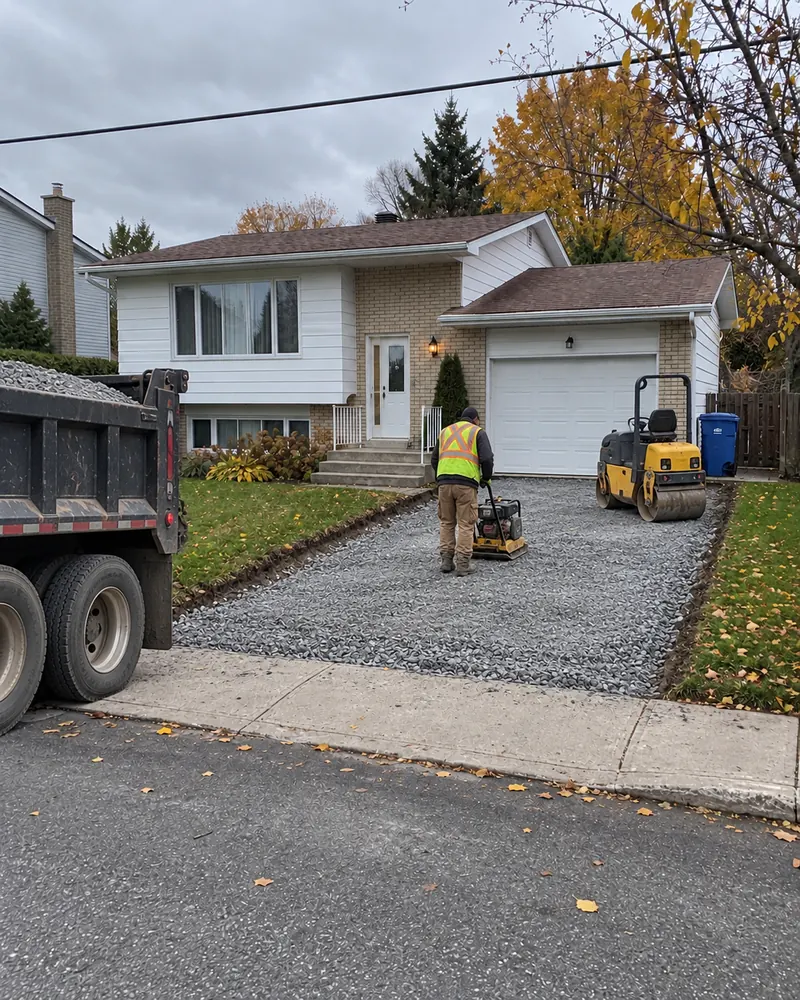
Paving advice
Resurfacing or rebuilding
The five-step test to find out what your driveway needs
Resurfacing costs about half as much as a rebuilt driveway, but it only holds on a base that still carries the load. Five checks, three of which you can do yourself after a rain, almost always settle it.
- Free quoteWe come take a look, no obligation.
- Clear priceEvery step spelled out in the quote.
- Hot asphaltLaid with a paver, rolled.
- Quick callbackThe owner, not a salesperson.
On this page
The short answer
- Resurface if the driveway is flat, drains to the street and has only fine or isolated cracks: $3–5.50/ft² in 2026, 10 to 15 more years according to Protégez-Vous and the APCHQ.
- Rebuild if the driveway ripples, holds water, breaks into a web of cracks or heaves every winter: $6–10/ft², over 20 years targeted by CAA-Québec.
- Combine when the damage is concentrated in one spot: we rebuild the zone that failed, then resurface the whole driveway. It is often the cheapest option per year of service.
What each option changes, and what it leaves in place
| Resurfacing | Rebuilding | |
|---|---|---|
| What comes out | Nothing, except a strip milled at the transitions | All the asphalt and the soft soil |
| What is redone | The surface: 40–50 mm of mix bonded to the old | The stone base, the slopes, then the asphalt |
| What stays under the car | The old base, good points and bad | A new base, compacted in lifts |
| Time on site | One day | Two days |
| 2026 price for 400 ft², before tax | $1,200–2,200 | $2,400–4,000 |
A new layer takes the shape of what it covers. The Federal Highway Administration sees it on roads: cracks in the old pavement come back up through a thin overlay, faster when the base moves. So the whole decision comes down to one question: does the stone still carry the load?
The test, step by step
1. The straightedge, after a rain. Lay a straight 10-foot (3 m) board on the driveway, in the wheel path, then across it. Québec’s transport ministry considers that a surface deviating more than 8 mm under a 3 m straightedge needs a levelling course. A dip deeper than 2 cm that holds water points to settled or washed-out stone at that spot.
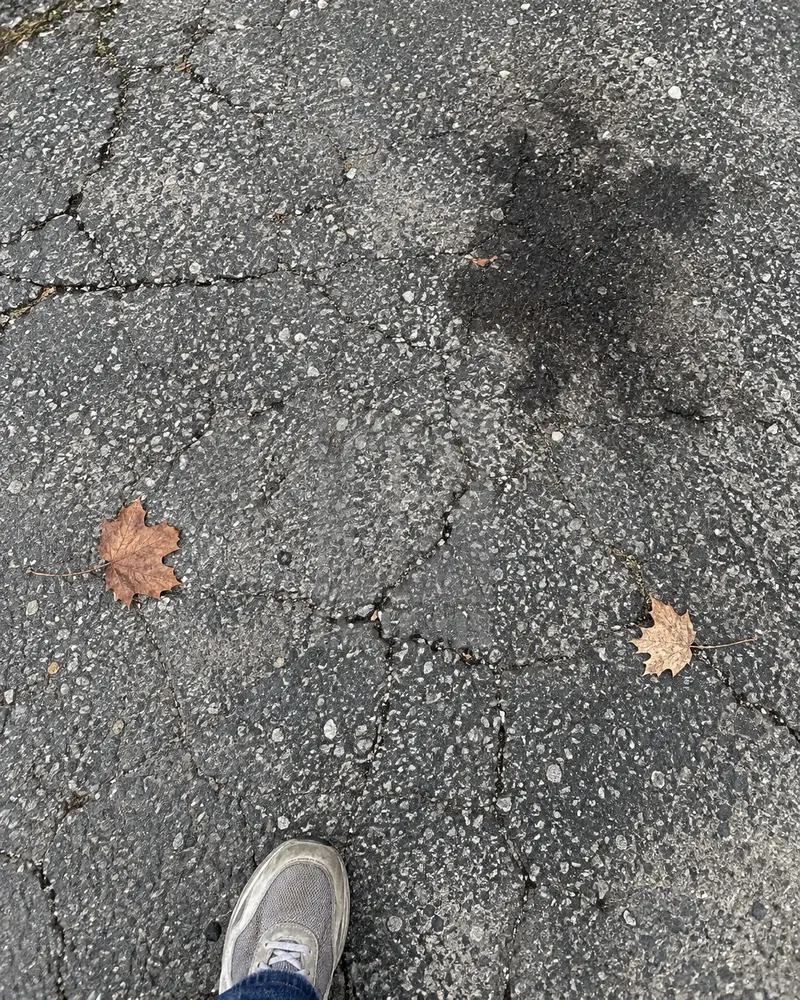
2. The shape of the cracks. A straight, isolated crack, across the driveway or along a joint, comes from the mix shrinking in the cold: it can be repaired. A web of small pieces, like alligator skin, comes from a base that flexes under the wheels: the Federal Highway Administration treats it as a sign of structural fatigue.
3. Winter behaviour. A bump that appears in January and settles in May means water freezing under the asphalt, in poorly drained soil. A new layer will heave the same way.
4. The slope. Pour a bucket of water at the top of the driveway. If it runs toward the garage or sits in the middle, resurfacing won’t fix it: it follows the existing slope.
5. Probing the edge. This is our step during the visit: we open up the edge of the driveway to measure the asphalt thickness and see the stone beneath. Many driveways laid when a house was built have only a few centimetres of stone, far from the 30–45 cm of excavation CAA-Québec recommends in sand.
The verdict, based on what you found
| Result | Verdict |
|---|---|
| Flat, drains to the street, fine or isolated cracks, grey surface | Resurfacing |
| Flat, but a few potholes or one local dip | Hot repairs, then resurfacing |
| Alligator cracking or dips concentrated in one spot, the rest sound | Combined fix: zone rebuilt, then the whole driveway resurfaced |
| Alligator cracking over a large part, ripples, puddles | Rebuild |
| A bump that comes back every winter | Rebuild with drainage corrected |
| Water running toward the house | Rebuild, to redo the slopes |
| Already resurfaced, and every crack came through the layer | Rebuild: a second layer would follow the same path |
Tell us what you found: the questionnaire gives you a first answer in 2 minutes
The math that decides: cost per year
| Option, 400 ft² driveway | 2026 price, before tax | Years claimed | Cost per year |
|---|---|---|---|
| Resurfacing on a sound base | $1,200–2,200 | 10 to 15 years (Protégez-Vous and APCHQ) | about $80–220 |
| Resurfacing on a failed base | $1,200–2,200 | a few winters, often 5 years or less | $240 and up |
| Rebuild | $2,400–4,000 | 15 to 20 years and more (NAHB; CAA-Québec) | about $120–270 |
Resurfacing wins clearly on a sound base and loses on a failed one: you then pay for the rebuild a few years later, on top of the layer. The combined fix is priced zone by zone: 80 ft² rebuilt at $6–10/ft², or $480–800, plus resurfacing the driveway.
Three profiles we see often
The driveway laid when the house was built. It was done quickly, on little stone, before the backfill had finished settling; CAA-Québec advises waiting 6 to 12 months. It ripples or sinks in its first years: that’s the base, so a rebuild.
The 15- to 25-year-old driveway, grey but flat. The stone did its job; it’s the surface that aged. This is the ideal resurfacing case, often with a few cracks sealed before the layer.
The driveway widened one day, without the same stone. The added part sinks and a crack follows the seam. We rebuild the added strip on the same depth of stone, then resurface the whole thing for a single finish.
What the quote should say, by option
- Resurfacing: the repairs done before the layer, tack coat over the whole surface, the compacted thickness (50 mm), milling at the transitions.
- Rebuilding: the excavation depth, the stone and its compacted thickness, fabric over clay, the slope, the compacted asphalt thickness.
- Both: the reason for the choice. A quote that offers a layer without looking at the base sells a price, not a fix.
Our two services describe each step: asphalt resurfacing and excavation and foundation. The guide on how to choose a paving contractor lists the questions to ask.
We probe your base for free and give you both prices
Frequently asked questions
How do I know if my driveway can be resurfaced?
It can if it is flat under a 3 m straightedge, drains to the street and has only fine or isolated cracks. Widespread alligator cracking, dips that hold water or a bump that returns every winter point to a base that needs redoing.
What is the price difference between resurfacing and rebuilding?
In 2026, resurfacing costs $3–5.50/ft² and a fully rebuilt driveway $6–10/ft², before tax. For 400 ft², that is $1,200–2,200 versus $2,400–4,000.
Can a driveway that was already resurfaced be resurfaced again?
Yes, if the base holds and the first layer didn’t let every old crack through. If they all came through, a second layer would follow the same path: rebuilding is better.
Does resurfacing fix cracks?
It covers fine, isolated cracks that are repaired before the layer. It doesn’t fix cracks that come from the base, such as alligator cracking or frost cracks: they come back up through the new layer.
Can just part of the driveway be rebuilt?
Yes. When the damage is concentrated in one spot, we rebuild that zone with its base, then resurface the whole driveway for an even finish. It is often the cheapest option per year of service.
Sources
- Québec transport ministry, Guide technique sur la mise en place des enrobés bitumineux (2009): levelling course, deviation under a 3 m straightedge, repairs before an overlay.
- Federal Highway Administration, The Use of Thin Asphalt Overlays for Pavement Preservation (FHWA-HIF-19-053, 2019) and Distress Identification Manual.
- CAA-Québec and Bitume Québec, technical sheet on the residential asphalt driveway (2011).
- Protégez-Vous and APCHQ, « Comment donner une deuxième vie à votre entrée en asphalte » (August 15, 2023).
- National Association of Home Builders and Bank of America, Study of Life Expectancy of Home Components (2007).
- Prices: Casabella Pavage (December 2025) and Les Pavages Guilmain (January 2026), compiled on our price page.
Go further.
How much does an asphalt driveway cost in 2026?
Québec asphalt prices: rebuilding $6–10/ft², resurfacing $3–5.50, plus sealcoating and crack repair. Sources and a project budget calculator.
Read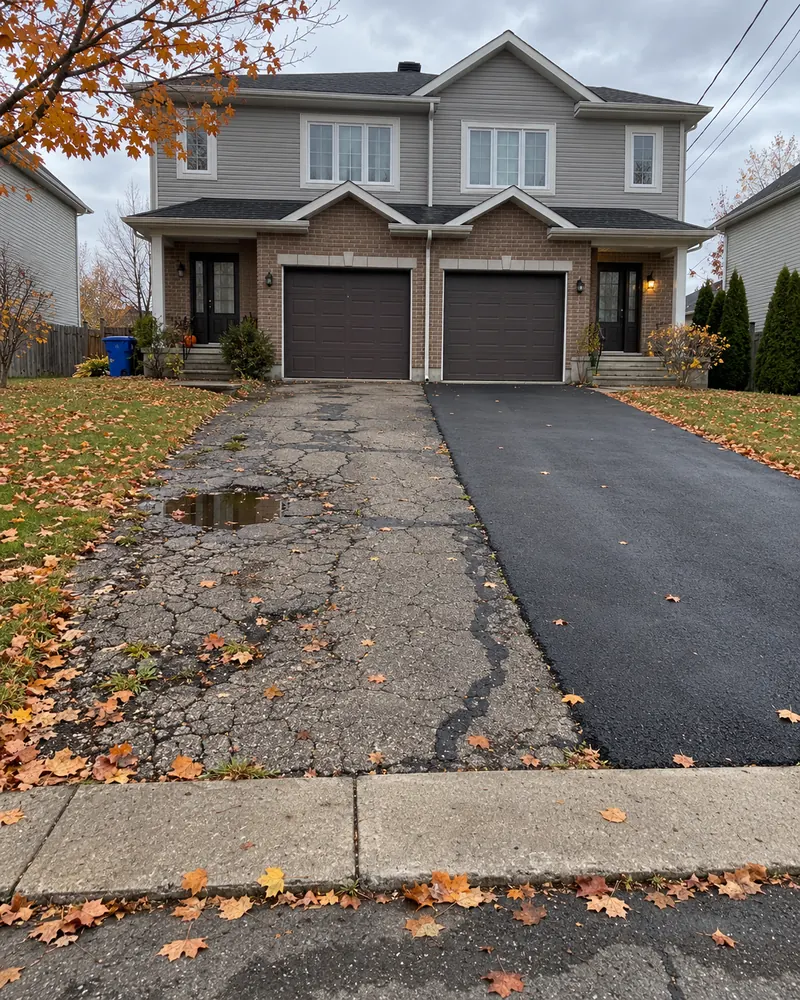
How many years does an asphalt driveway last in Quebec?
Built right, an asphalt driveway lasts 15 to 20 years or more in Quebec. The 6 benchmarks to demand, how to read the damage, and the cost per year of each fix.
Read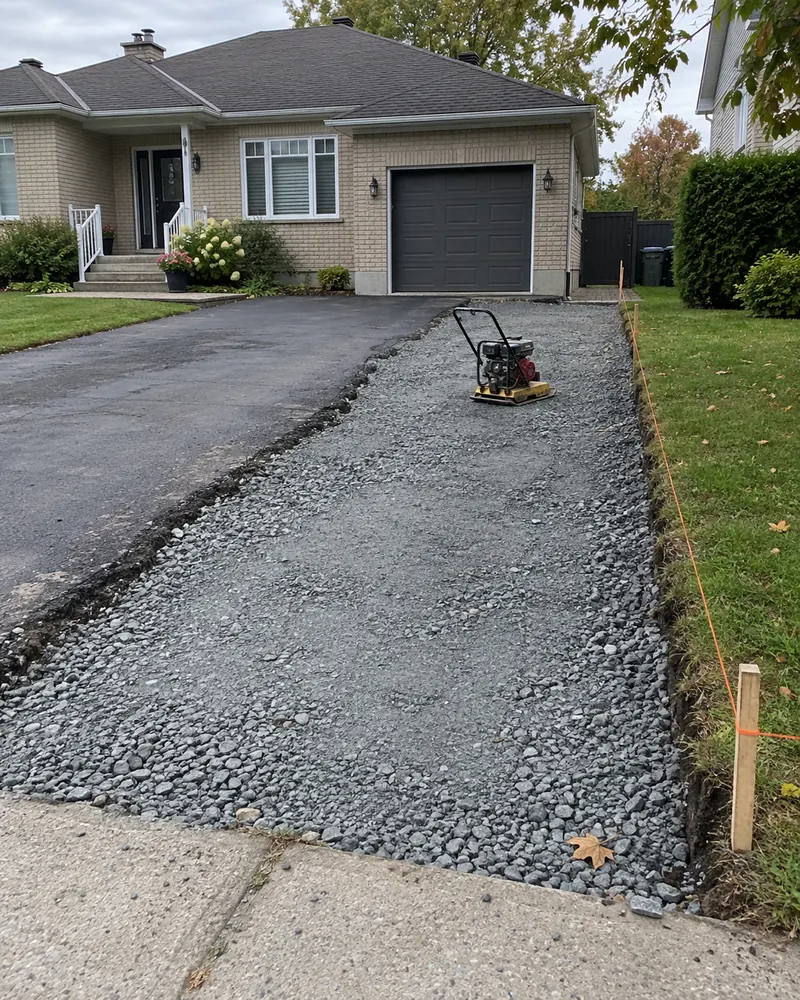
Driveway permits: what 16 cities require (rules checked in 2026)
Repaving as is, gravel to asphalt, widening: what Laval, Terrebonne, Longueuil, Brossard and 12 other cities require. Widths, curb cuts, fees and deadlines.
ReadBefore the freeze, not next spring.
Describe your project in two minutes. We call you back quickly, come take a look and you get your price, free.