Paving advice
Redoing a parking lot without closing
The phasing plan, night by night
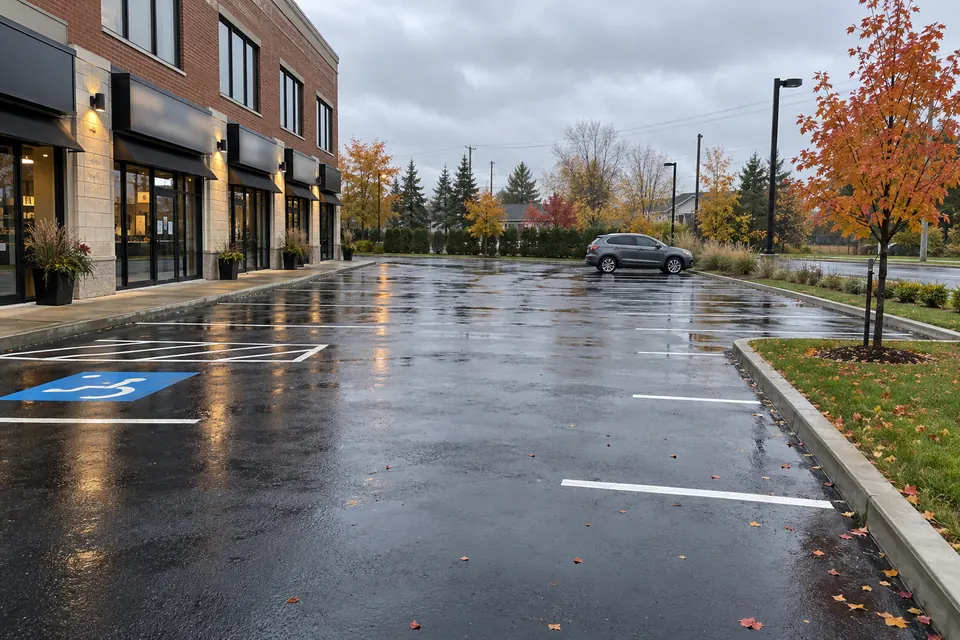
A 60-stall parking lot can be resurfaced in four nights without ever closing the main entrance during business hours. Here is the sample plan we adapt to each site, the limits set by the weather, and what your customers or tenants need to know before the first night.
- Free quoteWe come take a look, no obligation.
- Clear priceEvery step spelled out in the quote.
- Hot asphaltLaid with a paver, rolled.
- Quick callbackThe owner, not a salesperson.
On this page
- The short answer
- A sample plan: 60 stalls, two entrances, a loading dock
- What sets the length of each phase
- Limits set by the weather and the season
- Notices for customers and tenants
- Condos and apartment buildings: the same plan, other constraints
- After the work: keeping the lot in shape
- Frequently asked questions
- Sources
The short answer
A business stays open when the lot is divided into zones that always leave an entrance, an exit and some stalls free, and each zone is worked outside opening hours. A milled and paved zone reopens to cars as soon as the mix has cooled; striping comes last. For a 60-stall lot being resurfaced, plan on about four nights.
A sample plan: 60 stalls, two entrances, a loading dock
Take a small strip mall: 60 stalls, a main entrance on the boulevard, a secondary entrance on the side street and a delivery lane at the back. The lot is divided into three zones.
| Night | Zone closed | What stays open | Work |
|---|---|---|---|
| 1 | C: delivery lane and dock | Both entrances, every stall | Milling, base repairs, catch basins reset, paving |
| 2 | B: east half of the stalls | Main entrance, 30 stalls | Edge milling, repairs, paving |
| 3 | A: main entrance aisle | Secondary entrance, 30 stalls | Milling, paving, tie-in to the city sidewalk |
| 4 | No full closure, section by section | Everything but the section being painted | Striping: stalls, arrows, accessible stalls |
Deliveries move off night 1 or come in before 10 p.m.; the dock reopens the next morning. The real plan depends on your hours, your deliveries, the city and the most worn zones: the ones trucks use are often done first, with a heavier thickness.
Describe your parking lot and your hours: we propose a phasing plan
What sets the length of each phase
- Milling. A milling machine removes a strip of old asphalt along curbs, catch basins and tie-ins, so the new layer meets them at full thickness.
- Base repairs. Zones that flex under trucks are opened down to the stone and recompacted before the layer; that is what keeps the ruts from coming back.
- Paving and compaction. The mix is spread with a paver and rolled while it is hot.
- Cooling. The transport ministry’s guide opens a road to traffic once the mix is below 45 °C through its depth; on a parking lot, a zone paved in the evening reopens in the morning.
- Striping. Lines go down on mix that has cured enough, often on a later night, at about $13 per standard stall and $65 per accessible stall (Groupe Soli, 2026).
Limits set by the weather and the season
- Temperature: the transport ministry’s general specifications require air of at least 10 °C and rising for a compacted layer under 50 mm, and at least 2 °C above that. Cool fall nights therefore suit thicker layers better.
- Rain: no paving in rain or on a wet or frozen surface; a phase slips by a night, and we let your occupants know.
- Asphalt plants: night work depends on a plant producing at night; we confirm it before setting dates.
- Noise: several cities regulate noisy night work; we check the by-law and, if needed, move milling to the evening.
Notices for customers and tenants
A job that catches people by surprise draws more complaints than a noisy one. Before the first night, you receive:
- A zone plan with dates, to post at the entrance and in the lobbies.
- A notice ready to send to tenants or staff: which zone, which night, where to park, and the time cars must be moved by.
- Temporary signage on site: cones, barriers and signs pointing to the open entrances.
- A number to reach during the work.
Cars left in a zone due for paving are the first cause of delay; a reminder the day before, posted and sent, takes care of most of them.
Condos and apartment buildings: the same plan, other constraints
In an apartment building or condo, residents don’t leave in the evening. We then work by day, half the lot at a time, with temporary parking on the street or at a commercial neighbour, and avoid garbage collection days. For a condo board, the survey done before the work also serves the maintenance log and the contingency fund study: see our page on condo and apartment parking lots.
After the work: keeping the lot in shape
| When | What we do | Why |
|---|---|---|
| Every spring | Inspection after the thaw | Spot cracks, sunken catch basins and edges broken by the plough |
| Every summer | Cracks hot-sealed, $250–400 below 200 linear feet | 4 to 8 years of service per sealing on the ministry’s roads |
| Every 2 to 4 years | Surface sealcoat and restriping | Keep the aggregate in place and the stalls visible |
| Before winter | Markers along islands and catch basins | Keep the plough from breaking them |
The technical details, from asphalt thickness to catch basins, are on our commercial parking lot paving page, and our winter driveway guide applies to a parking lot too.
Frequently asked questions
Can a parking lot be repaved without closing the business?
Yes. We divide the lot into zones that always leave an entrance, an exit and some stalls open, and work each zone outside opening hours. A 60-stall lot is resurfaced in about four nights.
How long before a paved zone can reopen?
Until the mix has cooled: the transport ministry opens a road once it is below 45 °C through its depth. A zone paved in the evening usually reopens the next morning.
Can you pave at night in the fall?
Yes, if the air is at least 2 °C and rising for a layer of 50 mm or more, or 10 °C for a thinner one, on a dry, unfrozen surface, and if the asphalt plant is producing at night.
When is striping done after paving?
On mix that has cured enough, often on a later night. Striping costs about $13 per standard stall and $65 per accessible stall in 2026.
How should tenants be told?
With a zone plan posted and a notice sent before the first night: zone, date, the time cars must be moved by and where to park. A reminder the day before prevents most delays.
Sources
- Québec transport ministry, Cahier des charges et devis généraux, art. 13.3.4 (minimum temperatures, rain, frozen surfaces).
- Québec transport ministry, Guide technique sur la mise en place des enrobés bitumineux (2009): opening to traffic.
- Québec transport ministry, crack-sealing practice (4 to 8 years).
- Groupe Soli, 2026 striping rates.
2026 prices in detail: sources and calculator.
Go further.
Commercial parking lot paving: the right thickness for your trucks, zone by zone, without closing
Paving and rebuilding parking lots for businesses, apartment buildings and warehouses: 80 mm of asphalt and more, catch basins, zone-by-zone night or weekend work, $13 striping.
ReadYour building’s parking lot, priced for your budget and redone without closing.
For condo boards, property managers and businesses: a priced condition survey of your parking lot for the maintenance log and contingency fund (Bill 16), zone-by-zone work, one point of contact.
Read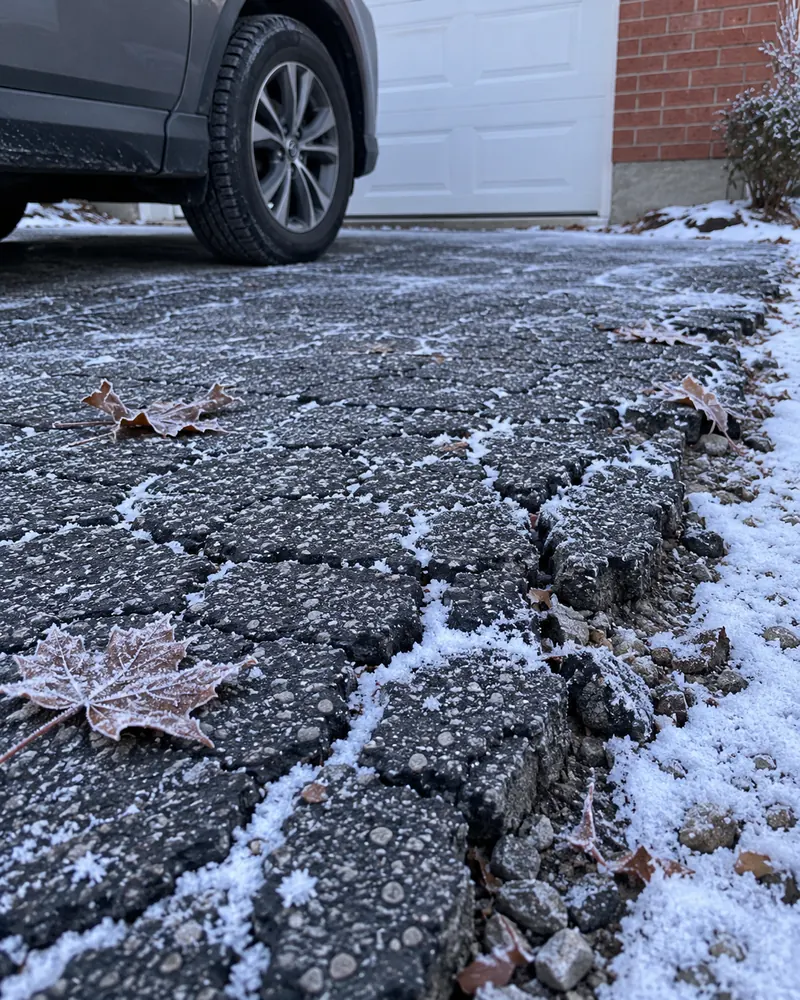
Your asphalt driveway and winter: what to do in October, in January and at the thaw
What to do for your asphalt driveway before the snow, during winter and at the thaw: cracks to close before the freeze, markers, de-icers, the plough blade, Tempo shelters and heavy trucks in spring.
ReadBefore the freeze, not next spring.
Describe your project in two minutes. We call you back quickly, come take a look and you get your price, free.